Mumbai’s skyline of glass-and-concrete towers looks stunning — but those same materials and the city’s density create real headaches for mobile connectivity.
In high-rise residences and commercial towers, weak signals, frequent call drops and slow data are common. Properly designed signal-boosting solutions — installed in coordination with telecom operators — can dramatically improve voice and data performance indoors.
This article explains how they work, why high-rises struggle, legal/regulatory considerations in India, practical options for building owners, and a step-by-step checklist for improving connectivity the right way.
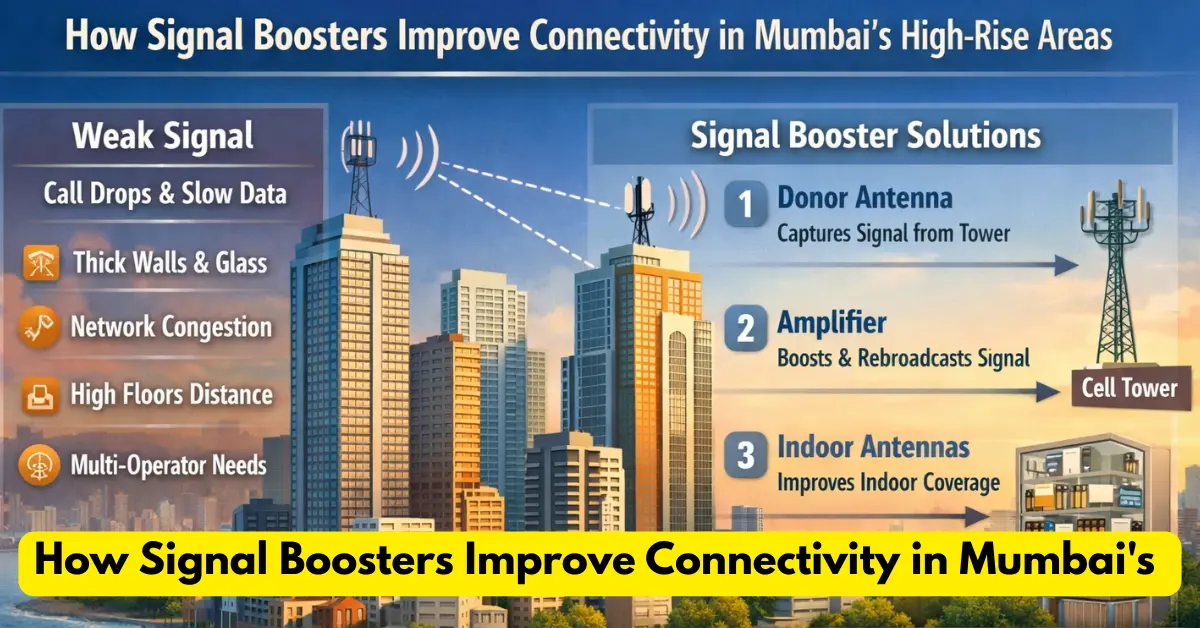
Why high-rises in Mumbai have poor mobile signal connectivity
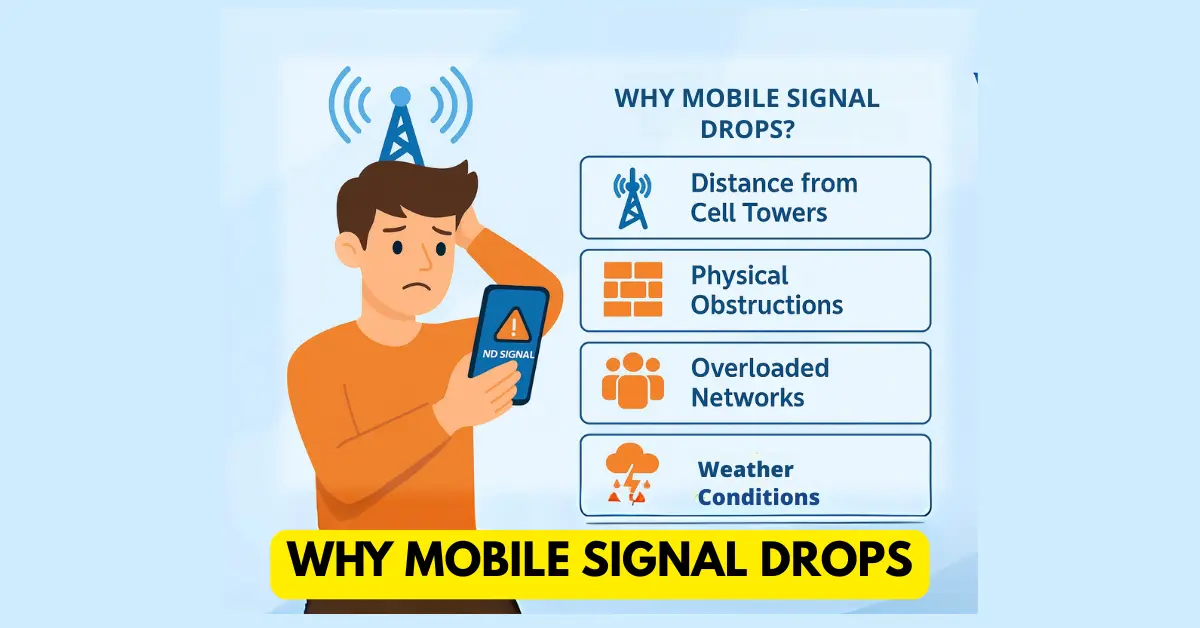
A few consistent factors make skyscrapers connectivity-challenged:
-
Material penetration loss: Reinforced concrete, metal frames, and energy-efficient glass attenuate radio signals so outdoor tower signals struggle to reach deep inside buildings.
-
Line-of-sight and distance: Taller floors can be farther (in RF terms) from the nearest macro cell or have blocked line-of-sight, reducing received signal strength.
-
Network congestion: Dense user concentration in residential towers or office floors increases demand; when many users compete for limited radio resources, perceived signal quality and speeds fall.
-
Multi-operator complexity: Multi-tenant buildings need coverage for several mobile network operators (MNOs) — requiring coordinated solutions to serve everyone reliably.
These are engineering realities that must be addressed with a combination of careful radio planning and the right indoor coverage technology.
What a signal booster actually does to improve mobile signal in mumbai
There are several indoor coverage technologies. The two most common approaches for high-rises are in-building solutions (IBS) — often implemented via Distributed Antenna Systems (DAS) or small cells — and operator-grade repeaters/amplifiers when permitted.
Basic components and operation (signal boosters / repeaters)
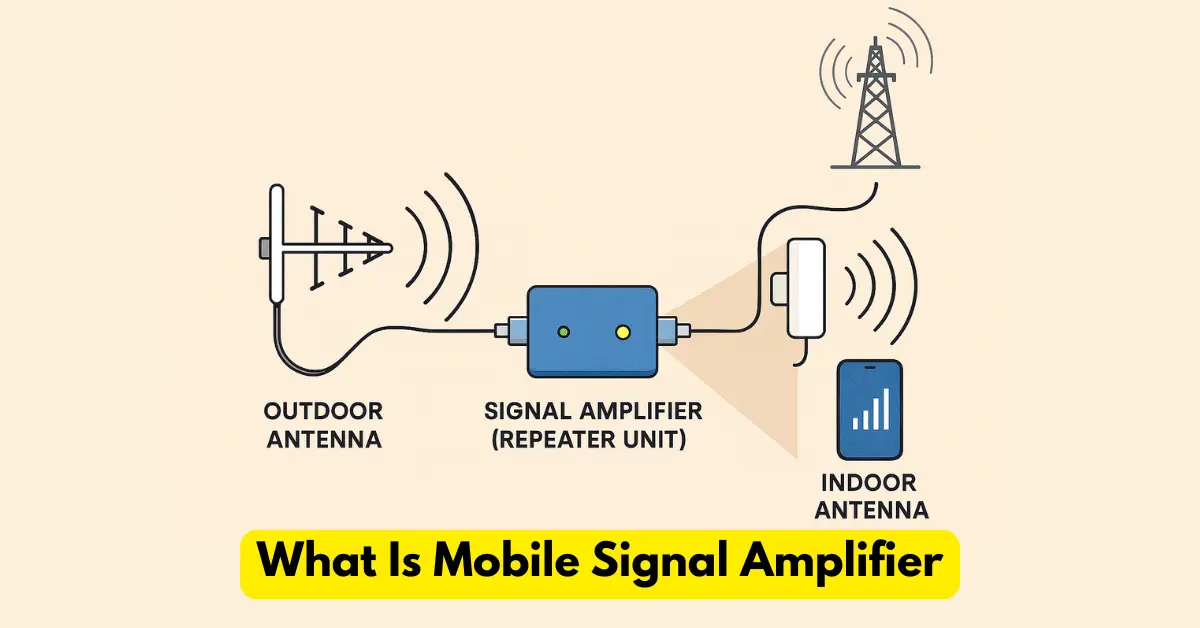
A typical repeater/amplifier-based setup has three parts:
-
Donor (outdoor) antenna — mounted where it can pick up the strongest outdoor signal from the operator’s tower.
-
Amplifier (the booster) — receives the donor antenna feed, amplifies the radio signals, and sends them to indoor antennas. It also forwards uplink signals back to the tower.
-
Indoor antennas — distributed through the building (floor-by-floor or by zones) to radiate the amplified signal where users are located.
When engineered well, the system reduces call drops, increases call quality and boosts mobile data speeds inside the building. (General descriptions of IBS/DAS and repeaters are standard in telecom engineering references.)
Distributed Antenna Systems (DAS) & Small Cells
-
DAS spreads many low-power antennas around a building connected to a central signal source; it’s ideal for large high-rises and multi-tenant complexes.
-
Small cells are compact base stations that provide local coverage and capacity; they’re useful where capacity (many simultaneous users) is the bottleneck.
Both options are widely used by operators as in-building solutions and are scalable to serve multiple operators when designed as a neutral host or multi-operator DAS.
Read More : What Is Mobile Signal Amplifer
Legal and regulatory landscape in India (what building owners must know)
Important: in India the possession, sale or use of mobile signal repeaters/boosters by private parties is tightly regulated. Government and telecom authorities have repeatedly warned that unauthorised repeaters or consumer boosters may be unlawful and can cause interference with operator networks. Building owners and managers should never install grey-market boosters without operator approval. Key regulatory points:
-
The Department of Telecommunications (DoT) has issued advisories that it is unlawful for individuals or entities other than licensed Telecom Service Providers to possess, sell or use mobile signal repeaters/boosters.
-
Customs and other agencies restrict imports of unauthorised repeaters to prevent interference and protect network quality. The CBIC has instructed field offices to allow only DoT-approved mobile signal equipment.
-
TRAI publishes regulations and guidance related to quality of service and in-building solutions; operators typically deploy IBS/DAS or small cells in coordination with regulators and building owners. For legal compliance, always seek operator approval and documented permission before installing any active RF equipment.
Bottom line: don’t buy or plug in consumer boosters from marketplaces. Work with the building’s management and the mobile network operators (or accredited vendors) to deploy approved IBS/DAS or small cell solutions.
How properly-installed mobile signal boosters improve real metrics
When an in-building solution is engineered and deployed correctly, building occupants will typically observe:
-
Fewer call drops and better call clarity — because phones see stronger, more stable RSSI and SINR indoors.
-
Faster and more consistent data speeds — uplink/downlink throughputs improve when the handset has a stronger, cleaner radio link.
-
Better battery life on phones — devices spend less power trying to find or hold a weak external signal.
-
Higher capacity for many users — DAS or small cells can be sized to handle heavy user density (office floors, multiplexes, residential complexes).
Case studies and operator whitepapers show that a professionally engineered IBS/DAS can reduce drop rates and increase average throughput substantially compared with no indoor solution.
Practical steps for building owners and facility managers in Mumbai
-
Run a professional RF site survey. Don’t guess — get an RF engineer to map dead zones, measure tower direction and signal levels on each floor.
-
Engage the mobile operators early. MNOs may already have in-building plans or preferred neutral-host vendors. Joint planning avoids later regulatory or interference headaches. (Mumbai examples show operator/authority coordination matters.)
-
Choose the right technology: small building = passive booster or small cell (operator-approved); large tower or multi-tenant = DAS / neutral host IBS.
-
Use licensed, certified equipment and accredited integrators. Make sure vendors have approvals and the installation follows DoT/TRAI/operational guidelines.
-
Plan for multi-operator requirements. If several operators need coverage, request a multi-operator DAS or neutral-host solution to avoid later disputes.
-
Document permissions and SLAs. Secure written agreements covering maintenance, uptime expectations, and responsibility for interference issues.
Cost considerations & ROI
-
Upfront costs vary widely: a small passive system for a single-owner building can be relatively modest; a full active DAS for a multi-tower complex or commercial skyscraper is a larger CAPEX project.
-
Ongoing costs include maintenance, power, and potential service charges if a neutral-host vendor or operator manages the system.
-
ROI shows up as tenant satisfaction, reduced complaints, higher rental desirability for offices/residences, and fewer service tickets. For commercial buildings, improved connectivity can impact business operations (video calls, real-time apps, payment systems) — often justifying the investment.
For exact estimates, request quotes from accredited IBS/DAS integrators and compare options (passive vs active DAS vs small-cells).
Alternatives and interim measures for residents & offices
While permanent operator-grade solutions are ideal, there are legal interim steps individuals and buildings can take:
-
Wi-Fi calling / VoWiFi: Many operators support voice over Wi-Fi — an immediate way to reduce call drops if the building has robust Wi-Fi.
-
Fixed broadband + Wi-Fi offload for data: Encourage people to use Wi-Fi for heavy data usage where possible.
-
Coordinate with neighbours and building management to log common complaint areas — aggregated demand helps get operator attention faster.
-
Report coverage issues via operator complaint channels and regulator portals to push for network improvements.
Avoid installing consumer-grade boosters bought online — they can harm the network and may be illegal.
Quick checklist: Deploying a legal, effective indoor solution in Mumbai
-
Hire a certified RF surveyor for floor-by-floor measurements.
-
Contact the major mobile operators (Airtel, Jio, Vi, etc.) with your survey results.
-
Choose between small cells, passive repeaters (operator-approved), or DAS depending on size and multi-operator needs.
-
Use DoT/CBIC/TRA I compliant, licensed equipment and installers.
-
Sign an operating/maintenance SLA and schedule periodic RF audits.
FAQs
Q: Are signal boosters legal for private use in Mumbai?
A: Unauthorised possession or use of mobile signal repeaters/boosters by private individuals or entities is not permitted. Building owners should work with licensed telecom providers or approved vendors for legal solutions.
Q: Will a consumer booster bought online solve my apartment’s call drops?
A: Likely not — and it may cause interference to cellular networks. Many consumer boosters are not compliant with Indian regulatory requirements and are discouraged. Always opt for operator-approved in-building solutions.
Q: What’s the difference between DAS and a signal booster?
A: A booster (repeater) amplifies an operator’s existing signal for a local area; a DAS is a network of distributed antennas fed from a central source and is typically used for larger, multi-floor installations and multi-operator support.
Q: Who pays for in-building solutions in commercial buildings?
A: Models vary: the building owner may pay, operators may share costs, or a neutral host vendor may install and charge operators or tenants. Clarify ownership, cost and SLAs before deployment.
Conclusion
Mumbai’s high-rise living and working experience shouldn’t include constant call drops or slow uploads. The right indoor coverage strategy — based on a professional RF survey and implemented with operator-approved in-building solutions (DAS, small cells, or approved repeaters) — delivers reliable voice and data for residents and businesses while staying within India’s regulatory framework.
If you manage a building or run facilities in Mumbai and want a compliant, engineer-backed plan to fix indoor mobile connectivity, we can help. Get a professional site survey, options comparison, and a quotation tailored to your tower(s) and tenant needs.
Ready to improve connectivity?
Visit Mobile Signal Amplifier to request an on-site RF survey and operator-coordinated IBS/DAS proposal. And visit mobile signal booster in mumbai for custom solutions.