
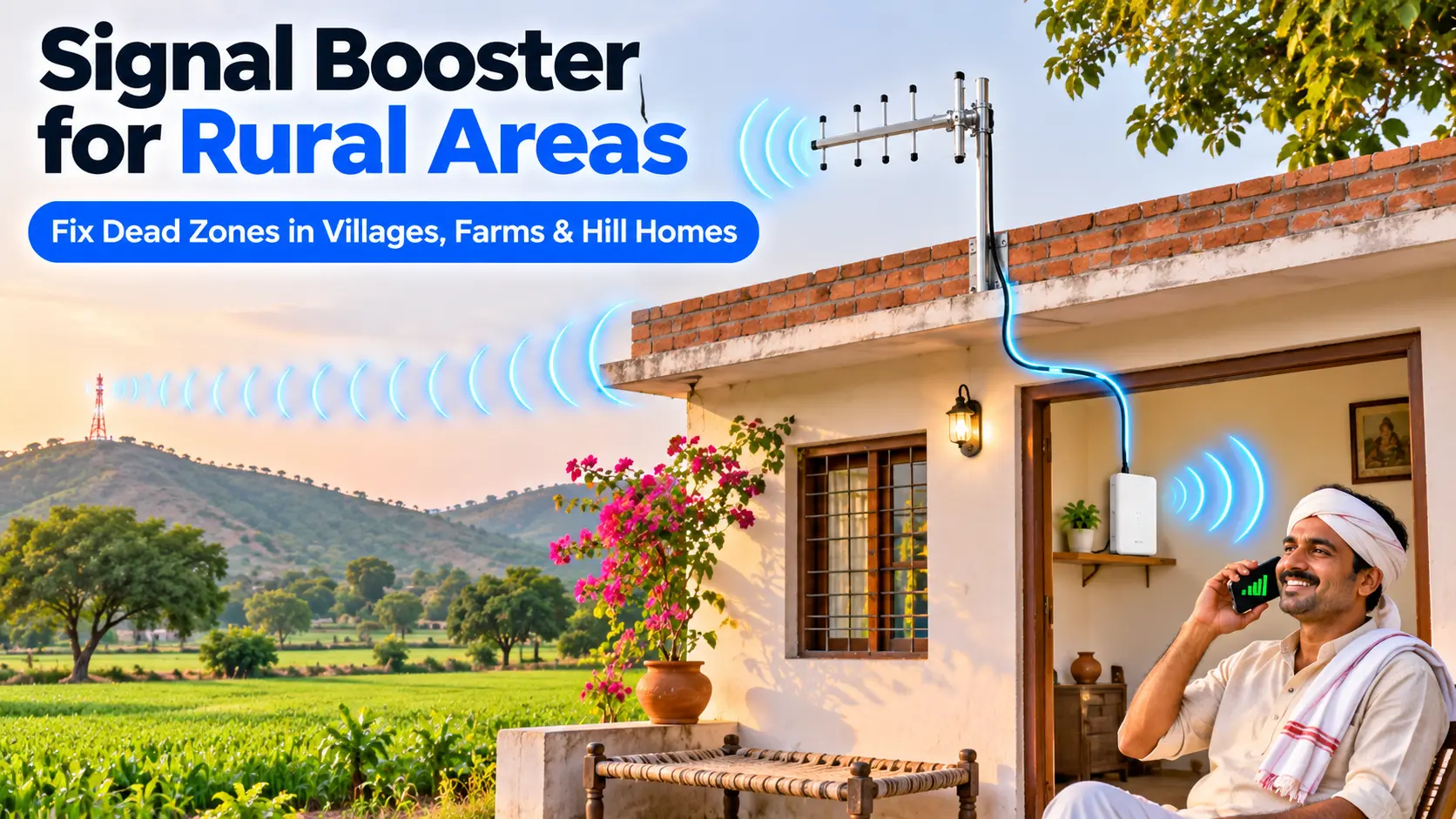
Access to consistent mobile connectivity remains a major hurdle across many rural parts of India. While urban centers frequently benefit from dense cellular infrastructure, countryside locations, agricultural farmlands, remote villages, and elevated hill stations often suffer from weak signals, frequent call drops, delayed SMS delivery, and unstable mobile data. If you live or work in a remote location, a reliable signal booster for rural areas becomes essential to maintaining communication with family, managing business operations, and accessing online services.
Cellular coverage indoors is frequently much worse than it is outside. A phone might show one or two signal bars on a rooftop or in an open field, but as soon as you step inside a village home, farmhouse, or mountain cottage, the signal collapses into a total dead zone. Mobile signal amplifiers address this problem by taking weak, usable outdoor cellular signals, amplifying them through dedicated electronic hardware, and re-broadcasting them inside your building. This guide explains how rural cellular coverage works, why signal loss happens in remote locations, how booster systems operate, and what practical factors you must evaluate before choosing a coverage solution.
Understanding the Rural Signal Problem: BTS Distance and Terrain Barriers
To understand why cellular reception is poor in rural locations, it helps to examine how mobile networks are structured. Cellular networks rely on Base Transceiver Stations (BTS)—commonly referred to as cell towers. In metropolitan cities, cell towers are installed every few hundred meters to handle high population density and heavy traffic. In rural India, however, cell towers are spaced much farther apart, sometimes separated by 5 to 15 kilometers or more.
Distance from the serving cell tower creates several technical challenges for mobile devices:
- Free-Space Path Loss: As radio frequency (RF) signals travel through the atmosphere, their energy naturally disperses over distance. By the time a signal reaches a distant farm or village, its power level (measured in dBm) has dropped significantly.
- Topographical and Physical Obstacles: Rural landscapes feature natural barriers such as hills, mountain ridges, valleys, and dense tree foliage. Unlike flat open areas, terrain obstacles block direct line-of-sight between your mobile device and the BTS, causing reflection, diffraction, and heavy signal attenuation.
- Building Material Attenuation: Village homes and rural structures in India are often constructed with thick brick walls, concrete slabs, stone masonry, or metal roofing sheets. While these materials provide durability and climate protection, they act as severe barriers to electromagnetic waves. A weak outdoor signal often cannot penetrate these building materials, creating complete indoor dead zones.
- Mobile Device Output Limits: Smart phones operate on small internal batteries and have limited output power. Even if a distant cell tower can transmit a signal to your phone, your phone may lack the power to send a signal back to the tower. This bi-directional imbalance leads to silent calls, audio cut-offs, and dropped connections.
How Outdoor Antennas and Signal Amplifiers Work in Remote Locations
A cellular signal booster system does not create a radio signal from nothing; instead, it captures an existing outdoor signal, increases its signal power, and distributes it to indoor areas where reception is blocked. A standard equipment setup for a remote installation consists of four primary components working in sequence.
1. High-Gain Outdoor Donor Antenna
The outdoor antenna, often called the donor antenna, is installed at a high point on the building, such as a roof mast, chimney, or utility pole. In rural applications where cell towers are distant, directional antennas—such as Yagi-Uda or Log-Periodic Dipole Array (LPDA) antennas—are typically used. Unlike omnidirectional antennas that pull signals from all directions, directional antennas focus their reception capability toward a specific point on the horizon. This directional focus allows the antenna to pick up weak radio signals from a distant BTS tower that a handheld phone cannot detect reliably.
2. Low-Loss Coaxial Cabling
The donor antenna connects to the interior amplifier unit via specialized coaxial cable. Because radio signals attenuate rapidly over thin wiring, low-loss coaxial cables are critical in rural installations. These shielded cables transport the captured RF signals from the roof to the amplifier with minimal signal degradation.
3. Mobile Signal Booster Unit
The booster unit is the central processing engine of the system. Installed indoors, it receives the weak RF signal sent from the outdoor antenna, filters out ambient electronic noise, and amplifies the signal voltage. The level of amplification is measured in decibels (dB) gain. A higher gain rating allows the booster to process weaker input signals and cover larger indoor spaces.
4. Indoor Service Antenna
Once the signal is amplified, it is sent to one or more indoor service antennas. These antennas are mounted on ceilings (dome antennas) or walls (panel antennas) inside the building. They broadcast the boosted signal directly to mobile phones, cellular modems, and IoT devices within the room, restoring clear voice calls and stable cellular connections.
Cellular Operator Landscape in Rural India: BSNL, Vi, Airtel, and Jio Context
Mobile network deployment across rural India varies by regional geography and operator strategy. Understanding how cellular providers operate in rural areas helps set realistic expectations for signal boosting solutions.
- BSNL (Bharat Sanchar Nigam Limited): BSNL has an extensive footprint across remote villages, border regions and deep rural pockets where private operators historically had limited infrastructure. Its 4G now runs on 2100 MHz and the low 700 MHz band (nationwide since 2025), with 2G on 900 MHz. Low bands travel farther over open terrain, which helps in villages far from a tower.
- Vodafone Idea (Vi): Vi has significant rural subscriber bases in specific circles. In rural belts it relies mainly on the low 900 MHz band for coverage, with 1800 and 2100 MHz for 4G capacity. Rural Vi users often lose signal indoors in pukka houses despite moderate outdoor coverage.
- Bharti Airtel: Airtel covers most rural areas with 4G on the low 900 MHz band, backed by 1800 and 2100 MHz where towers are closer. 5G (3500 MHz) is mostly limited to towns and does not travel far.
- Reliance Jio: Jio’s rural 4G coverage depends heavily on its low 850 MHz band, with 1800 and 2300 MHz in towns. Jio 5G also uses 700 MHz in some areas. Jio has no 900 or 2100 MHz band, so a booster for Jio must cover 850 MHz.
When choosing a signal booster for rural areas, the amplifier must support the specific frequency bands broadcast by your local telecom operator at your specific geographical site. A multi-band booster can amplify signals for multiple operators at once, provided those frequencies are present outside the building. For a full operator-by-operator breakdown, see our Jio vs Airtel vs Vi vs BSNL band comparison.
Choosing Signal Boosters for Farms, Villages, and Hill Stations
Rural installations present distinct environment challenges. Tailoring your signal enhancement setup to your specific building style and landscape topology is necessary for optimal performance.
Farms and Agricultural Properties
Farmhouses and agricultural sheds are often isolated in open fields, far from town infrastructure. Because there are few surrounding structures to block line-of-sight, the primary challenge is sheer distance to the BTS tower.
Recommended Approach: Use a high-gain directional outdoor antenna mounted high above tree lines. Paired with a high-gain amplifier, this configuration captures weak signals from distant towers across open ground. If coverage is needed across both an indoor living space and outdoor equipment yards, multi-antenna expansion kits may be considered.
Village Homes and Pukka Constructions
In rural villages, residential structures are often built close together using heavy brick, concrete, and metal roof framing. Outdoor signals may be adequate in open street lanes or on roofs, but indoor spaces suffer from complete signal blockages.
Recommended Approach: An outdoor antenna mounted on the rooftop captures the clean outdoor signal. Indoor panel antennas, mounted on main floor walls or hall ceilings, push the amplified signal directly through interior living spaces, bypassing the heavy exterior masonry.
Hill Stations and Mountain Resorts
Topography in hilly regions like Himachal Pradesh, Uttarakhand, the North-East, or the Western Ghats creates severe line-of-sight obstruction. A cell tower located in a valley may not reach a home situated on an opposing slope or behind a mountain ridge.
Recommended Approach: Careful outdoor site surveying is necessary to identify where usable signal reflected off adjacent hillsides or ridge lines accumulates. Highly directional LPDA antennas placed on elevated masts are aligned precisely toward the strongest incoming signal vector.
Comparison: Technical Solutions for Rural Cellular Deficits
Mobile signal boosters are one of several methods used to address poor rural reception. The table below compares common approaches to rural cellular connectivity challenges:
| Solution Method | Primary Function | Requires Existing Outdoor Signal? | Multiple User Support? | Key Practical Limitation |
|---|---|---|---|---|
| Mobile Signal Booster | Amplifies weak outdoor cellular RF signals and rebroadcasts them indoors. | Yes (Needs a usable baseline outdoor signal). | Yes (Supports all cellular devices within range). | Cannot function if zero outdoor signal exists anywhere nearby. |
| Wi-Fi Calling (VoWiFi) | Routes voice calls over an existing fixed line or satellite broadband connection. | No (Relies on wired/fixed broadband). | Yes (Requires connection to local Wi-Fi router). | Requires a functional, high-speed, stable internet connection. |
| High-Gain Outdoor Router | Uses an outdoor SIM-based modem to convert cellular data into local Wi-Fi. | Yes (Needs outdoor 4G/5G coverage). | Yes (Provides data connectivity over Wi-Fi). | Provides local internet/data only; does not directly boost phone RF voice bars. |
| Passive Antenna Extensions | Connects physical external antenna cables directly into cellular modems. | Yes (Needs outdoor signal capture). | No (Direct cable connection to single hardware port). | Only works with devices equipped with physical external antenna ports. |
Signal Strength vs. Data Speed: Realities of Rural Performance
A common misconception is that installing a mobile signal amplifier will automatically guarantee high-speed internet. It is important to distinguish between signal strength (power level) and signal quality (data throughput capacity).
Signal amplifiers improve signal strength by increasing the RF power (measured in dBm) inside your home. When your phone receives a stronger, clearer signal, it spends less energy trying to maintain a connection. This results in:
- Fewer dropped voice calls and improved call audio clarity.
- Faster delivery of SMS messages and time-sensitive One-Time Passwords (OTPs).
- Longer phone battery life, as the phone’s transmitter does not need to run at maximum output power.
- More stable data connections with reduced packet retry rates.
However, actual internet speed (throughput) is dictated by factors beyond signal power alone. Data performance depends on the bandwidth capacity of the cell tower, backhaul connectivity to the operator’s core network, local tower congestion, and signal quality (Signal-to-Interference-plus-Noise Ratio, or SINR). If a distant rural tower is overloaded with traffic or has limited backhaul bandwidth, boosting the signal strength will stabilize your data link, but actual download and upload speeds will remain capped by the cell tower’s underlying capacity.
Avoiding Network Interference
A poorly designed or badly installed amplifier can emit unwanted noise, oscillate, and disturb service on the operator’s tower for everyone nearby. To avoid this:
- Choose a booster with automatic gain control (AGC) and oscillation detection, which prevent feedback loops.
- Install it properly, with good physical separation between the outdoor and indoor antennas.
- Get advice from an experienced mobile coverage specialist such as Mobile Signal Amplifier on the right setup for your location.
Crucial Prerequisites Before Installing a Rural Booster
Before purchasing hardware, perform a site assessment to determine if your location meets the physical conditions needed for a signal booster system.
1. Verify the Outdoor Baseline Signal
A mobile booster amplifies an existing signal; it cannot generate cellular coverage out of thin air. You must verify that a usable cellular signal exists somewhere on your property—such as on the roof, an exterior wall, or an elevated mast. You can check this by taking your mobile phone to the roof and attempting to place a phone call or by checking the signal reading in your phone’s settings menu (measured in dBm). Here’s how to check your signal strength.
2. Ensure Sufficient Antenna Isolation
For a booster to operate properly without oscillating (causing internal feedback like a microphone held near a speaker), there must be adequate physical separation between the outdoor donor antenna and the indoor service antenna. This is achieved through:
- Vertical Separation: Placing the outdoor antenna several meters higher than the indoor antenna (e.g., roof vs. ground floor).
- Horizontal Separation: Keeping distance between the two units across the property layout.
- Shielding Barriers: Utilizing existing concrete floors or brick ceilings between the outdoor and indoor antenna locations.
3. Account for Cable Lengths and Attenuation
Long coaxial cable runs between the roof antenna and the amplifier unit reduce signal power. Always plan the shortest practical cable path, using high-quality low-loss cables to retain maximum signal strength from the outdoor antenna.
Frequently Asked Questions
Will a signal booster work if there is zero mobile signal outside my house?
No. A signal booster requires a minimum baseline cellular signal outdoors to capture, process, and amplify. If there is absolutely no signal available on your roof, surrounding trees, or nearby high ground, a signal booster will not function. In such zero-signal environments, alternative solutions like satellite internet or fixed broadband with Wi-Fi Calling (VoWiFi) are required. See our guide on how to boost mobile signal without a booster.
Can a rural signal booster increase my mobile internet speed?
A signal booster stabilizes your mobile data connection by eliminating signal drops and reducing data packet transmission errors. This allows your device to maintain a stable 4G or 5G connection. However, total internet speed ultimately depends on the network capacity, bandwidth, and congestion levels of your mobile operator’s cell tower.
Do signal boosters work with all Indian mobile operators like BSNL, Vi, Airtel, and Jio?
Signal boosters operate on specific radio frequency bands (such as 850 MHz, 900 MHz, 1800 MHz, or 2100 MHz). Multi-band boosters designed for the Indian market can amplify signals for BSNL, Vi, Airtel, and Jio simultaneously, provided the booster hardware supports the specific frequency bands broadcast by those operators in your region. Note that Jio needs 850 MHz, while Airtel, Vi and BSNL rely mainly on 900, 1800 and 2100 MHz.
What is the difference between a directional Yagi antenna and an omnidirectional antenna in rural areas?
An omnidirectional antenna receives signals from all 360-degree directions equally, making it ideal for urban areas with multiple nearby cell towers. A directional (Yagi or LPDA) antenna focuses its sensitivity in one specific direction, allowing it to reach much farther across rural terrain to pick up weak signals from distant cell towers.
Why does my mobile phone have signal outside in the farm, but drops inside the village home?
Building construction materials such as reinforced concrete, fired clay bricks, stone masonry, and metal roofing block cellular radio signals. While signal waves travel freely outdoors across your farm, they attenuate or reflect off your building’s exterior walls, creating indoor dead zones.
Conclusion
Dealing with poor cellular coverage in countryside homes, agricultural properties, and remote hill stations does not have to mean accepting missed calls, failed transaction OTPs, and unreliable communication. By understanding how terrain barriers and distance from cell towers create signal decay, rural residents and property owners can take targeted steps to solve remote dead zones.
Implementing a high-gain outdoor antenna paired with a properly calibrated mobile signal amplifier allows you to capture weak exterior radio signals and bring reliable, clear cellular coverage into your home or workplace. To explore tailored signal amplification options designed for homes, offices, farmlands, and commercial properties across India, visit MobileSignalAmplifier.com and evaluate the proper coverage setup for your specific location.