
Quick answer: A signal booster works with Jio, Airtel, Vi and BSNL, as long as it supports that operator’s bands and there is usable signal outside your building. Jio has no 2G, so it needs a booster with its 4G bands (1800, 850, 2300 MHz) or 5G band n78. Airtel and Vi mainly use 1800, 2100 and 900 MHz, and BSNL 4G uses 2100 and 700 MHz. For a home with mixed SIMs, choose a multi-band booster that covers 900/1800/2100 MHz, plus n78 if you want 5G.
Weak indoor mobile connectivity is a persistent problem across India. Poor reception, dropped calls and sluggish mobile data affect users on every network. For example, it happens in Mumbai high-rises, Delhi basement offices and warehouses in semi-urban Tamil Nadu. When faced with persistent coverage gaps, many property owners turn to mobile signal amplifiers to resolve their signal issues. However, this raises an important question: does one operator work better with a booster than the others?
Which Network Works Best with a Signal Booster?
The short answer is that no single operator is inherently “better” when paired with a booster. Instead, how well a mobile signal booster performs on any network depends on whether the amplifier supports the specific frequency bands deployed by that operator in your location, combined with the presence of a usable outdoor signal. Equipment needs also vary across carriers. Reliance Jio runs only on 4G LTE and 5G. Meanwhile, Bharti Airtel and Vodafone Idea (Vi) still keep a 2G layer alongside 4G and 5G, and BSNL runs 2G and 4G while switching off 3G. This article provides an in-depth comparative analysis of how each major Indian cellular provider interacts with mobile signal boosters, helping you choose the right solution for your home, office, or industrial space.
How Mobile Signal Boosters Interact with Cellular Networks
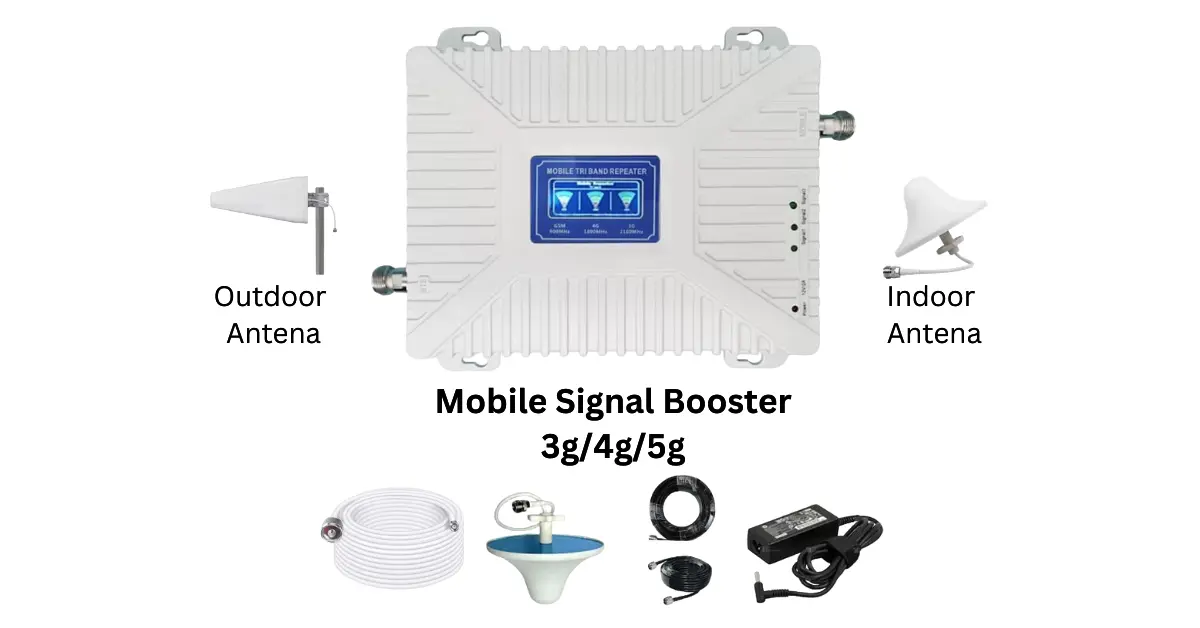
To understand how Jio, Airtel, Vi, and BSNL perform when amplified, it helps to review the basic architecture of a cellular signal booster system. A standard mobile signal booster setup consists of three primary hardware components connected by specialized low-loss coaxial cabling:
- Outdoor Donor Antenna: Mounted high on a roof, balcony, or outer wall where usable outdoor cellular signals exist. It captures radio signals from nearby operator base stations (cell towers).
- Booster Unit (Amplifier): Installed indoors, this unit receives the weak signal from the donor antenna, amplifies its strength (measured in decibels or dB), filters out background electrical noise, and sends it down the line.
- Indoor Service Antenna: Positioned inside living or working areas to rebroadcast the boosted signal directly to mobile phones, cellular modems, and IoT devices.
It is critical to note that a mobile signal booster cannot create a signal out of thin air. Instead, it captures an existing outdoor signal and amplifies it. It then broadcasts it past physical barriers like reinforced concrete, brick walls, low-E glass windows, and metal roofing. Therefore, regardless of whether you subscribe to Jio, Airtel, Vi, or BSNL, a usable outdoor signal is a mandatory prerequisite for any booster to operate.
Jio vs Airtel vs Vi vs BSNL — Network Compatibility Breakdown
Each major Indian telecommunications provider utilizes different network infrastructure, spectrum band allocations, and voice transmission protocols. Understanding these operational differences clarifies why specific signal booster configurations are necessary for each provider.
1. Reliance Jio and Signal Boosters
Reliance Jio operates an All-IP network comprising 4G LTE and 5G services. Unlike its competitors, Jio has no legacy 2G or 3G fallback network in India.
- Voice Architecture: Jio routes 100% of its voice traffic over Voice over LTE (VoLTE) or Voice over New Radio (VoNR). If LTE signal strength inside a building drops below the threshold needed to sustain a VoLTE connection, voice calls drop instantly because there is no 2G network to handle the call.
- Booster Requirements: To improve Jio reception, a signal booster must support the bands Jio uses in your area: 4G on 1800 MHz (Band 3), 850 MHz (Band 5) and 2300 MHz (Band 40), and 5G on n78 (3300 MHz) and n28 (700 MHz). See our 5G signal booster guide for the 5G side. Traditional single-band 2G boosters (such as 900 MHz GSM amplifiers) will not work with a Jio SIM card.
- Booster Performance: When paired with an LTE-compatible booster, Jio connections often see immediate improvements in indoor voice call stability, call setup times, and connection reliability. In Mumbai? See our Jio signal booster service in Mumbai.
2. Bharti Airtel and Signal Boosters
Bharti Airtel operates a multi-technology cellular network incorporating 2G, 4G LTE, and 5G services across India.
- Voice Architecture: Airtel delivers data primarily over 4G LTE and 5G bands, while voice calls are handled via VoLTE. However, if the 4G signal degrades significantly indoors, Airtel mobile devices can automatically fall back to 2G spectrum to keep voice calls connected.
- Booster Requirements: Airtel users generally benefit from multi-band signal boosters. To achieve both clear indoor voice calling and responsive mobile data, a booster that covers both 2G voice frequencies and 4G data bands is recommended.
- Bands to Look For: Airtel 4G mainly runs on 1800 MHz (Band 3) and 2100 MHz (Band 1), with 900 MHz (Band 8) and 2300 MHz (Band 40) in many cities. Airtel 5G Plus uses n78 (3300 MHz). A 900/1800/2100 MHz booster covers Airtel calls and most of its 4G data.
3. Vodafone Idea (Vi) and Signal Boosters
Vodafone Idea (Vi) maintains a substantial nationwide network footprint with active 2G and 4G LTE deployments, along with selective 5G rollouts.
- Voice Architecture: Vi uses 4G LTE for high-speed data and VoLTE calling, supported by an extensive 2G layer for traditional voice traffic in areas with limited 4G penetration.
- Booster Requirements: A signal booster for Vi must align with the spectrum bands active in your city or regional circle. Vi 4G uses 1800, 2100 and 900 MHz, plus 2300 and 2500 MHz in some cities, and Vi 5G (n78) is live only in selected cities. Boosters supporting lower frequency bands (which naturally penetrate concrete and brick structures better) combined with higher-frequency data bands provide optimal results.
- Booster Performance: Because Vi outdoor signal levels can fluctuate between urban centers and rural fringes, installing a high-gain outdoor donor antenna pointed precisely toward the nearest Vi cell tower often yields a major improvement in indoor call quality and data stability.
4. BSNL (Bharat Sanchar Nigam Limited) and Signal Boosters
State-owned BSNL maintains broad nationwide coverage, particularly in rural, semi-urban, and remote regions, operating 2G alongside its 4G network, which it rolled out nationwide in 2025. BSNL is now switching off 3G circle by circle and moving that spectrum to 4G.
- Voice Architecture: BSNL is moving calls to 4G VoLTE. In many areas, 2G on 900 MHz still carries a large share of voice calls.
- Booster Requirements: BSNL voice connectivity can frequently be improved using conventional GSM 900 MHz boosters or dual-band systems. However, to support BSNL mobile data alongside voice, the booster must support BSNL’s 4G bands: 2100 MHz (Band 1) and, in many areas, 700 MHz (Band 28).
- Booster Performance: BSNL coverage challenges in distant locations are often caused by long physical distances from cell towers rather than building shielding alone. High-gain outdoor directional antennas (such as Yagi or Log-Periodic antennas) paired with a compatible booster are effective at catching weak BSNL signals over long distances.
Operator Signal Booster Comparison Table
The table below summarizes the network characteristics and signal booster requirements for Jio, Airtel, Vi, and BSNL in India:
| Telecom Operator | Active Network Generations | Primary Voice Mechanism | Key Booster Requirement | Main Bands to Look For |
|---|---|---|---|---|
| Reliance Jio | 4G LTE, 5G | VoLTE / VoNR (No 2G/3G) | Must support Jio’s 4G and 5G bands (no 2G fallback). | 4G: 1800, 850, 2300 MHz 5G: n78 (3300), n28 (700) |
| Bharti Airtel | 2G, 4G LTE, 5G | VoLTE with 2G fallback | Multi-band (2G + 4G/5G) booster recommended. | 4G: 1800, 2100, 900, 2300 MHz 5G: n78 (3300) |
| Vodafone Idea (Vi) | 2G, 4G LTE, 5G | VoLTE with 2G fallback | Multi-band matching local circle spectrum. | 4G: 1800, 2100, 900, 2300, 2500 MHz 5G: n78 (selected cities) |
| BSNL | 2G, 4G (3G being switched off) | VoLTE with 2G fallback | 900 MHz for 2G calls; 2100 + 700 MHz for 4G. | 4G: 2100, 700 MHz 2G: 900 MHz |
Note: Operators do not use every band in every city. Check which band your phone is on with the codes in our guide to checking mobile network strength. A common 900/1800/2100 MHz tri-band booster covers Jio’s main 1800 MHz band and most Airtel, Vi and BSNL calls and data. It does not cover 5G (n78), BSNL’s 700 MHz or Jio’s 850 and 2300 MHz.
Key Factors That Determine Mobile Booster Performance
While operator network design is important, several site-specific physical factors ultimately determine how effectively a mobile signal booster performs inside a building.
1. Outdoor Signal Strength and Signal Quality
Cellular signal strength is measured in decibel-milliwatts (dBm) (here is how to check it on your phone), typically ranging from -50 dBm (excellent signal near a tower) to -110 dBm or lower (extremely weak signal / near dead zone).
- Strong Outdoor Signal (-60 dBm to -80 dBm): The booster operating at full efficiency can cover extensive indoor floor space (e.g., multi-story homes or large offices).
- Weak Outdoor Signal (-95 dBm to -105 dBm): The booster will amplify the signal, but the effective indoor coverage radius around the service antenna will be smaller.
- Zero Outdoor Signal (No Service): A booster cannot work, as there is no input signal to capture and amplify.
In addition to raw signal strength, signal quality (Signal-to-Noise Ratio or SINR) is equally crucial. A clean outdoor signal allows the booster to deliver clear voice quality and consistent data packet transmission indoors.
2. Matching the Specific Frequency Spectrum
Mobile networks communicate over specific radio frequency bands measured in Megahertz (MHz). Boosters are engineered to amplify defined spectrum ranges. For example, a booster built for a band your operator does not use in your city will not improve your reception. Verifying the active frequency bands in your area before selecting equipment is a critical step.
3. Building Architecture and Structural Materials
Modern building construction presents severe obstacles to cellular radio waves. Dense materials cause substantial signal attenuation:
- Reinforced concrete walls and thick brickwork absorb radio waves.
- Metal sheets, corrugated iron roofs, and structural steel reflect signals away.
- Double-glazed energy-efficient windows with metallic oxide coatings (Low-E glass) block high-frequency cellular signals.
- Basements and underground parking structures are shielded by surrounding earth and stone.
A mobile signal booster solves this structural problem by mounting an antenna outside the building envelope, catching the unblocked signal, and transferring it indoors via shielded coaxial cable past all structural barriers.
4. Data Speed Expectations and Network Capacity
It is important to maintain realistic expectations regarding mobile data speeds. A signal booster stabilizes cellular signal conditions, reduces packet drops, and prevents your device from constantly searching for connection. As a result, your phone or 4G/5G router can talk to the cell site as efficiently as current conditions allow.
However, a signal booster cannot override cell tower congestion. If a serving cell tower is overloaded with local user traffic or has limited backhaul capacity, internet speeds may remain constrained even when your phone displays maximum signal bars indoors.
Choosing the Right Solution for Multi-Carrier Environments
In multi-occupant environments like corporate offices, commercial centers, hospitals, hotels, or shared apartments, individuals rely on different network providers. One user may use Jio, another Airtel, and others Vi or BSNL.
Installing a single-band booster tailored to just one network creates coverage disparities for subscribers on other networks. The solution for multi-user facilities is a multi-band mobile signal booster (such as a dual-band, tri-band, or quad-band kit). Multi-band amplifiers simultaneously process multiple frequency ranges, allowing users on Jio, Airtel, Vi, and BSNL to receive boosted signals through a single, unified antenna infrastructure.
At MobileSignalAmplifier.com, multi-carrier coverage challenges are met by assessing outdoor signal conditions across all available networks, identifying active local frequencies, and configuring tailored signal amplifier systems for residential and commercial properties throughout India.
Frequently Asked Questions (FAQs)
1. Which network works best with a mobile signal booster in India?
There is no single “best” network. Mobile signal boosters work effectively with Jio, Airtel, Vi, and BSNL provided the booster unit supports the specific frequency bands used by that carrier in your local area and there is a usable outdoor signal to amplify.
2. Can a single signal booster amplify Jio, Airtel, Vi, and BSNL simultaneously?
Yes. A multi-band (such as a tri-band or quad-band) signal booster designed to cover the various frequency ranges used across Indian telecommunications operators can amplify Jio, Airtel, Vi, and BSNL signals simultaneously within the same building.
3. Why does my Jio SIM card not work with an older signal booster?
Older signal boosters were often single-band units designed exclusively for 2G GSM voice networks (typically 900 MHz). Because Jio is an All-IP network running only on 4G LTE and 5G, with calls over VoLTE/VoNR and no 2G layer, it requires an LTE-compatible multi-band booster to function.
4. Will a mobile signal booster work if there is no signal outside my house?
No. A signal booster amplifies existing outdoor cellular signals and brings them indoors. A booster cannot work if there is zero outdoor signal, meaning no network bars at all on the roof or exterior walls.
5. Does a mobile signal booster increase internet download speeds?
A signal booster improves signal strength and link stability, which eliminates signal dropouts and packet loss. While this enables your mobile device to achieve the best possible data rates allowed by the serving cell site, actual download and upload speeds still depend on total network traffic and tower capacity.
6. Why is my indoor cellular signal weak even if the outdoor signal is strong?
Weak indoor reception despite strong outdoor signal is typically caused by building attenuation. Dense building materials such as reinforced concrete, brickwork, metal roofing, and low-E glass windows block radio signals from penetrating into interior rooms, basements, or upper floor corridors.
7. How much does a multi-network signal booster cost in India?
For homes, a 4G booster typically costs ₹9,000–₹20,000 and a 5G-ready booster ₹12,000–₹30,000. Office systems for several floors usually start around ₹30,000. The price depends on the area you need to cover and how many bands the booster supports.
Conclusion
When comparing Jio vs Airtel vs Vi vs BSNL for use with a mobile signal booster, the determining factor is not the carrier itself, but matching the amplifier equipment to the operator’s local frequency bands and voice technology. Jio requires LTE/5G compatible boosters to handle VoLTE calls, while Airtel, Vi, and BSNL benefit from multi-band configurations that boost both legacy 2G bands and modern 4G/5G spectrum. If you are unsure whether you need 5G support at all, read 4G vs 5G signal booster: which one you need.
To successfully resolve weak indoor network coverage, start by measuring the outdoor signal strength around your building, identifying which networks require amplification, and selecting a properly configured multi-band system. Exploring tailored equipment options through MobileSignalAmplifier.com can help ensure reliable voice clarity and stable mobile connectivity across all major Indian cellular networks.
Not sure which bands your building needs? Call 09769403018 or WhatsApp us. We check the Jio, Airtel, Vi and BSNL signal at your home or office and recommend the right setup. Live demo at your location — free if you buy, and installation is free.