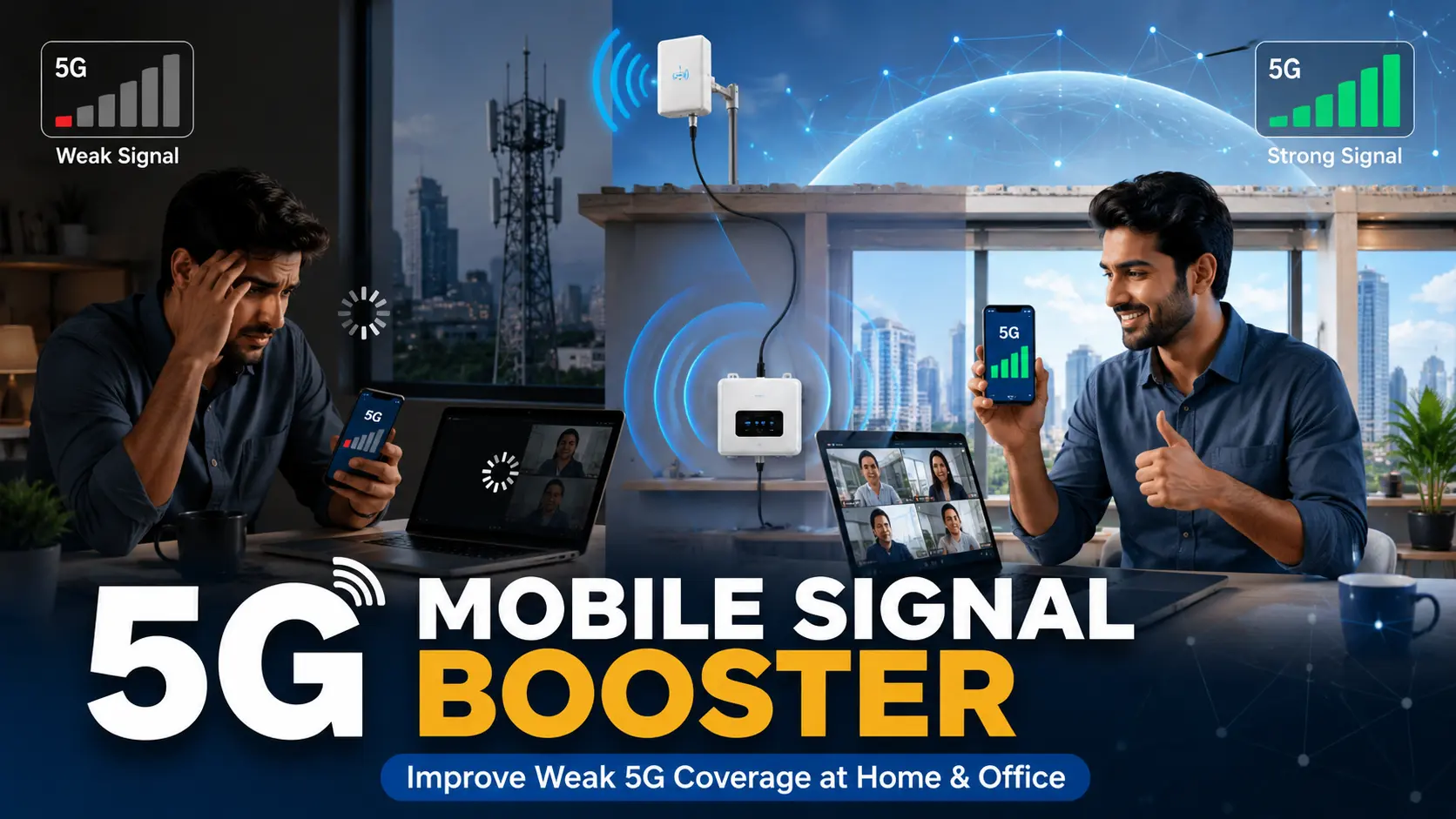
Picture this: you’re in a meeting room in Mumbai, your phone shows “5G” in the corner, but the call keeps breaking up. Or you’re working from a flat in Delhi with thick concrete walls, and data speeds crawl to a halt the moment you step away from the window. Sound familiar?
India’s 5G rollout has been genuinely impressive. According to the Department of Telecommunications, 5G services are now available in 99.9% of India’s districts, with over 5 lakh base stations installed nationwide by October 2025. On paper, the network is everywhere.
But “covered” on a map and “usable inside your building” are two very different things. Concrete walls, glass facades, and building materials block radio signals — regardless of whether they’re 4G or 5G. That’s where a mobile signal booster comes in. And right now, millions of Indians are asking the same question: should I get a 4G booster or invest in a 5G one?
This guide answers that question plainly. No jargon overload — just the information you need to make the right call for your home or office. If you’re not sure how a signal booster works in the first place, start there — then come back here to decide which generation fits your situation.
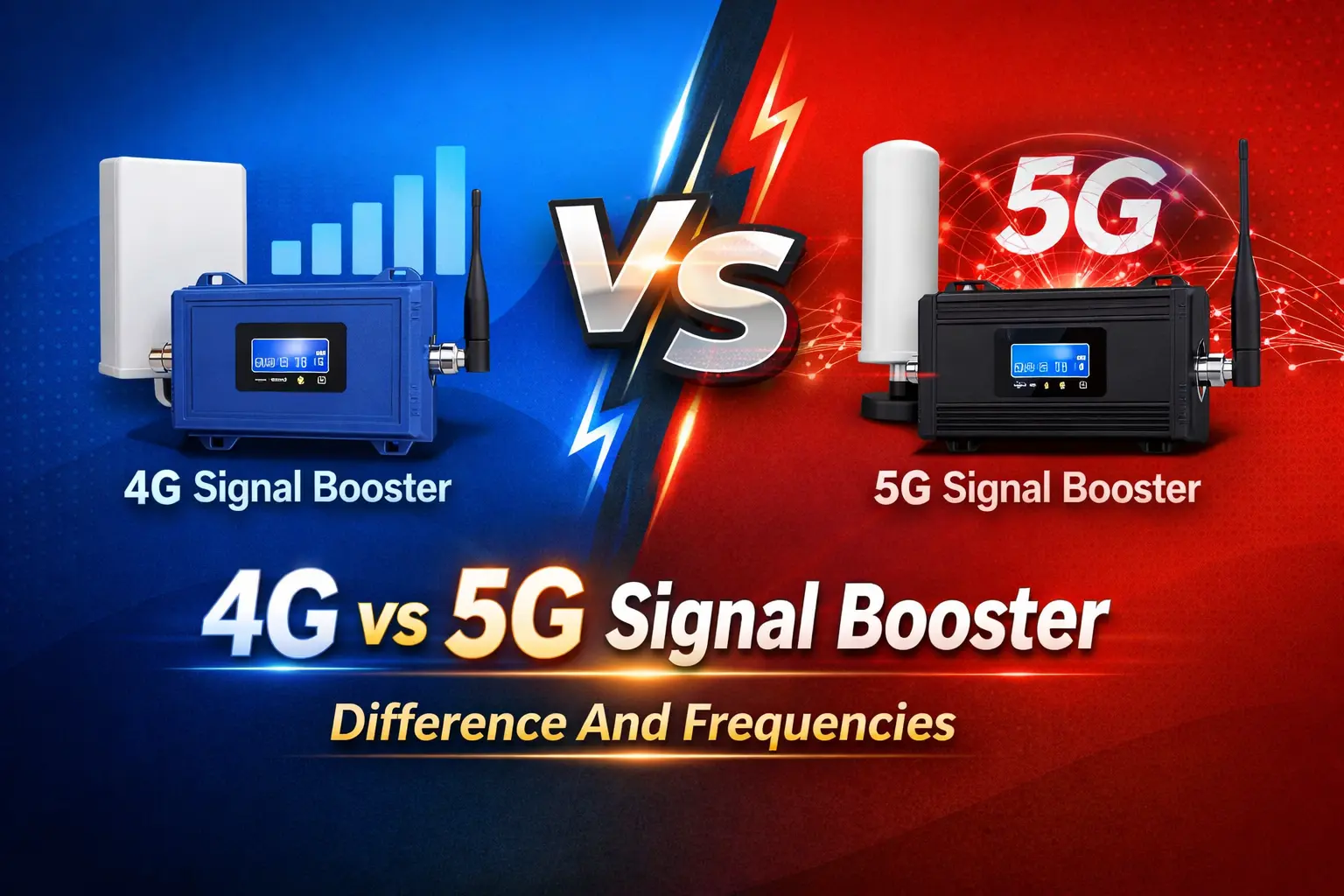
4G vs 5G signal booster – What’s the Real Difference Between?
At their core, a 4G booster and a 5G booster do the same thing: they capture a weak outdoor signal, amplify it, and rebroadcast it inside your building. The difference lies entirely in which radio frequencies each device is built to handle.
How 4G Boosters Work — and Why They’re Still Dominant
A 4G mobile signal booster is designed to amplify the frequency bands your LTE network runs on. In India, that means bands like 1800 MHz (Band 3), 2100 MHz (Band 1), and 850 MHz (Band 5) — used by operators like Airtel, Jio, Vi, and BSNL for their 4G services.
These boosters are mature technology: well-tested, widely available, and highly effective at eliminating dead zones indoors. Think of them like a water pump — they take the weak pressure trickling in from outside and push it into every corner of your space.
For the vast majority of users in India today — whether in a home, a café, or a mid-size office — the reason your signal drops indoors is a 4G LTE problem, not a 5G one. A quality 4G network booster solves it completely.
What a 5G Signal Booster Actually Does Differently
A 5G-capable booster is engineered to handle additional frequency bands introduced for 5G — most importantly, the n28 (700 MHz) and n78 (3300–3800 MHz) bands that Jio and Airtel use for their 5G networks in India. The 700 MHz low-band offers great indoor penetration, while the mid-band n78 delivers the faster speeds most people associate with 5G.
A 5G booster doesn’t replace your 4G booster — it extends what’s possible. The best models handle both generations simultaneously, so you get strong LTE as a fallback and 5G speeds where the signal supports it.
4G vs 5G signal booster – The Frequency Band?
Here’s the thing most people miss: buying a “5G booster” doesn’t automatically mean you’ll get 5G speeds inside. What actually determines performance is whether the booster supports the specific frequency bands your operator uses in your city.
4G vs 5G signal booster – Which Frequency Bands Does Each Booster Support?
| Feature | 4G Signal Booster | 5G Signal Booster |
|---|---|---|
| Primary Bands | 850, 1800, 2100 MHz | 700 MHz (n28), 3300–3800 MHz (n78) + 4G bands |
| Works With mmWave (26 GHz)? | No | No — no consumer booster can |
| Supports Mid-Band 5G (n78)? | No | Yes (select commercial models) |
| Suitable for Homes? | Yes | Yes (if 5G available outside) |
| Suitable for Offices? | Yes | Yes — future-ready |
| Price Range (India) | ₹15,000 – ₹60,000 | ₹40,000 – ₹1,50,000+ |
| Availability | Widely available | Growing |
It’s also critical to understand what cannot be boosted. High-band 5G (mmWave, above 24 GHz) cannot be amplified by any standard consumer or commercial booster — these signals travel only short distances and are primarily used outdoors in stadiums and dense city centres. No booster on the market changes this physics.
4G vs 5G signal booster – Does Your Area Even Have 5G Signal to Boost?
A booster cannot create signal from nothing — it can only amplify what already exists outside your building. Before spending on a 5G booster, check your actual outdoor signal strength in dBm, and confirm your operator provides 5G in your specific locality (not just your city). Jio’s 5G availability leads at over 70% of the time for its subscribers, while Airtel’s standalone 5G network is strong in metros — but coverage varies significantly by neighbourhood.
Is a 5G Signal Booster Worth the Extra Cost in India?
This is the question that matters most. The honest answer depends on where you are and what you actually need today.
When a 4G Booster Is the Smart Choice
- You’re in a Tier 2 or Tier 3 city where 5G mid-band coverage is still being built out.
- Your primary pain point is call drops and slow LTE data indoors — a 4G mobile signal amplifier solves this completely.
- You’re working with a limited budget and need results now, not in 18 months.
- Your operator (Vi, BSNL) has limited 5G rollout in your area.
- You run a small retail shop, restaurant, or home office where 4G speeds are entirely sufficient.
For the majority of homes, small offices, and businesses in India today, a high-quality 4G network booster delivers everything you need: clear calls, reliable data, eliminated dead zones — at a fraction of the cost of a 5G-ready system.
When to Invest in a 5G-Ready Booster
- You’re in a major metro (Mumbai, Delhi, Bengaluru, Hyderabad, Chennai) with confirmed mid-band 5G from Jio or Airtel in your area.
- You run a commercial space — a large office, hotel, hospital, or co-working centre — where future-proofing infrastructure makes financial sense.
- Your work demands high-bandwidth tasks like 4K video conferencing, large file transfers, or real-time IoT data.
- You’re building new infrastructure and won’t want to upgrade again for 5–7 years.
- Your team uses Jio Standalone 5G and experiences substantially higher speeds outdoors but dead zones indoors.
4G vs 5G signal booster – Which One To Choose For Home or Office?
The right booster depends on your space as much as your network. Here’s how to think about it.
Best Choice for Homes and Apartments
Most residential users — whether in a high-rise in Mumbai or a ground-floor apartment in Pune — are best served by a good multi-band 4G mobile signal booster. These cover 1,000 to 2,500 sq. ft. comfortably, work with all major operators simultaneously (Jio, Airtel, Vi, BSNL), and require no technical expertise to run. In high-rise apartments and concrete buildings, where walls can cut signal by 20–30 dB, even a mid-range 4G booster can transform your experience from frustrating to seamless.
If you’re on Jio and regularly experience 5G outdoors but lose it indoors, look for a tri-band or quad-band booster that explicitly lists the n28 (700 MHz) band in its specifications — this is the most boostable 5G frequency for residential use.
Best Choice for Offices and Commercial Spaces
For offices, the calculation changes. A commercial signal booster covering 3,000 sq. ft. or more needs higher gain (80–90 dB), a tri-band or quad-band configuration, and ideally compatibility with the n78 mid-band 5G spectrum that Jio and Airtel deploy in business districts. If you’re outfitting a new office in 2025 or beyond, the incremental cost of choosing a 5G-ready commercial booster pays off — you won’t need to rip out infrastructure when your team’s bandwidth demands increase. A mobile signal booster is not a Wi-Fi fix — it’s your entire cellular network indoors: voice calls, mobile data, IoT sensors, and payment terminals all benefit simultaneously.
Common Questions About 4G vs 5G Signal Boosters
Can a 4G Booster Work on 5G Networks?
A 4G booster will not amplify 5G frequencies — they’re different bands. However, in many parts of India, your phone switches between 4G and 5G depending on signal availability. A 4G booster will keep your 4G connection strong indoors, which is often more reliable than a patchy 5G connection. If you specifically want to boost indoor 5G, you need a booster that lists the n28 or n78 bands in its specifications.
Will a 5G Booster Become Outdated Quickly?
Not if you buy the right one. Current commercial-grade 5G boosters that support the Sub-6 GHz spectrum (700 MHz and 3300–3800 MHz bands) will remain relevant for the foreseeable future — these are the bands Jio, Airtel, and Vi have built India’s 5G on. The only 5G frequency that can’t be boosted — mmWave (26 GHz) — is primarily used for outdoor hotspots and stadiums, not indoor residential or office coverage. So a well-specified 5G booster you buy today will still be fully functional in 2030 and beyond.
Do Signal Boosters Need DoT Approval in India?
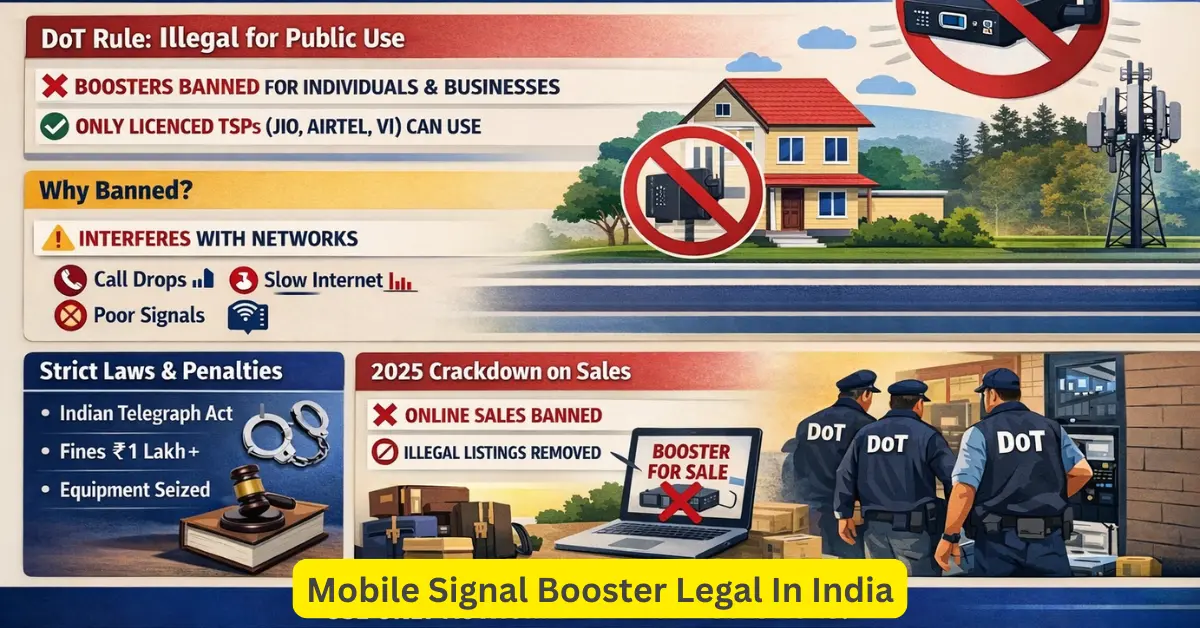
Yes. The Department of Telecommunications regulates signal boosters in India. Using an unapproved or uncertified booster can lead to penalties. Always purchase a booster from a reputable, compliant vendor who provides equipment that meets Indian telecom standards. A professional installation — with a properly mounted outdoor antenna and calibrated amplifier — also ensures you’re not causing interference to neighbouring towers or users.
How Do I Know If 5G Is Available Outside My Building?
Step outside your building and check what your phone shows: if it displays “5G” (not 5G+, 5G UW, or 5G UC), you’re most likely on low-band or mid-band 5G — the type that boosters can amplify. You can also use your phone’s Field Test Mode (iPhone) or an app like Cell Info Lite (Android) to see which exact frequency band you’re connected to. If you consistently see the n28 or n78 band indicator outdoors, a 5G-capable booster will bring that signal indoors effectively.
4G vs 5G signal booster – The Bottom Line
Here’s the short version: if you’re experiencing dropped calls, slow data, or signal dead zones in your home or office today, a quality 4G mobile signal booster solves your problem completely and costs less. Don’t wait for a 5G booster if your immediate pain point is a 4G issue.
If you’re building infrastructure for a commercial space in a metro city, or you consistently get strong 5G outdoors but lose it the moment you step inside, a 5G-ready network booster is a smart investment that won’t need replacing as India’s 5G matures through 2030.
At Mobile Signal Amplifier, we help homes, offices, hotels, hospitals, and industrial facilities across India find the right booster — with site surveys, professional installation, and solutions for every operator and frequency band. Whether you need a signal booster for home or a large-scale commercial signal booster, we’ll help you get it right the first time.