Quick answer: A 5G mobile signal booster for home picks up the weak 5G and 4G signal outside your building, amplifies it, and rebroadcasts it indoors. It helps when your phone shows 5G near the window but drops to one bar inside. In India, home boosters typically cost ₹9,000–₹30,000, depending on area covered and bands supported. For Jio, the booster must support the n78 (3300 MHz) band, and ideally n28 (700 MHz) too.
Your phone shows the 5G icon, yet videos buffer, downloads crawl and calls cut out the moment you walk into the bedroom. Sound familiar?
The problem usually isn’t your plan or your phone. It’s your building. Concrete walls, tinted glass and tall neighbouring towers block 5G signals far more than they block 4G.
This guide explains how a 5G mobile signal booster for home works, which bands Jio, Airtel and Vi use, what it costs in India, and how to pick one that actually fixes your problem.
What Is a 5G Mobile Signal Booster and How Does It Work?
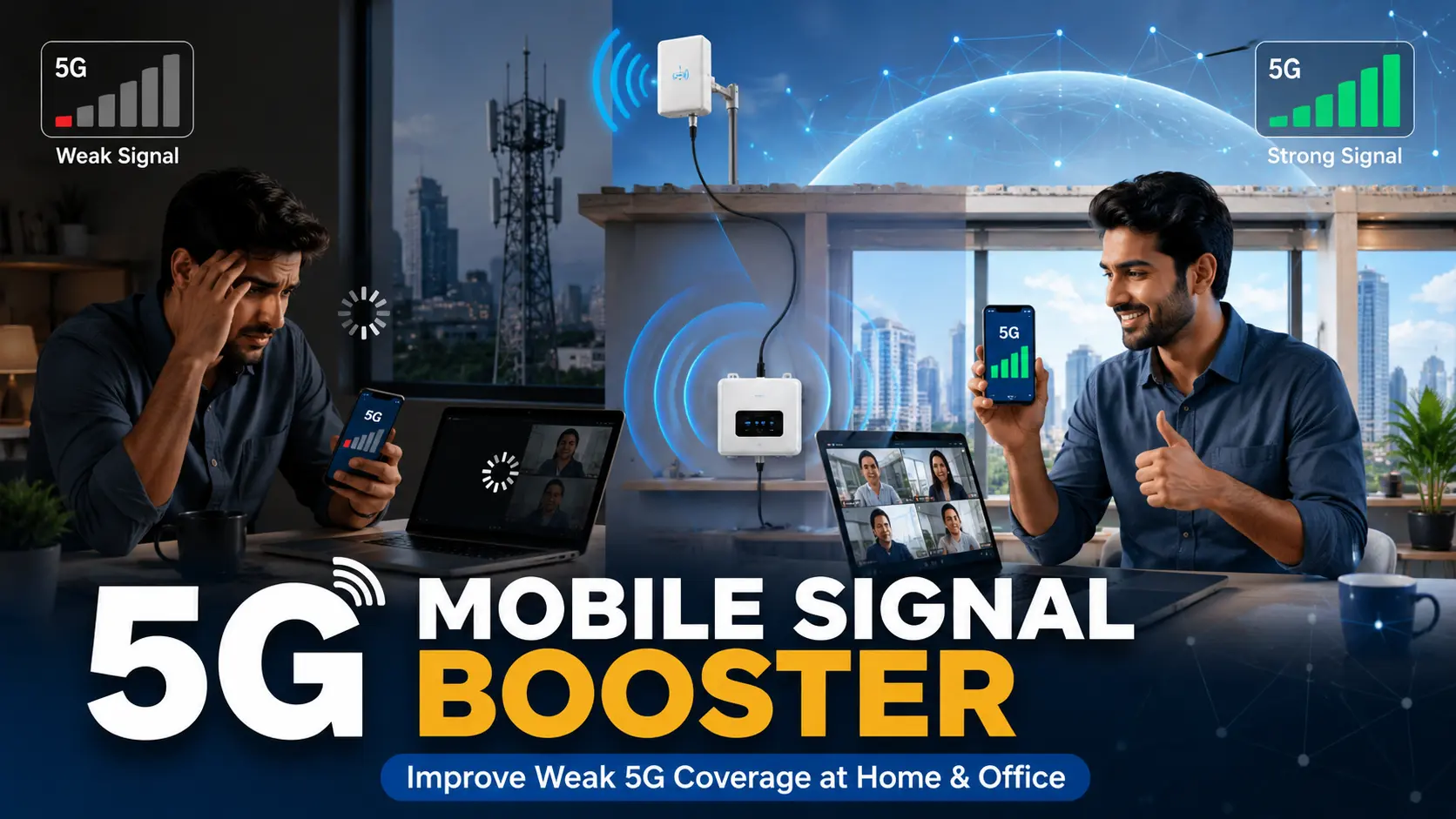
A 5G mobile signal booster (also called a 5G network booster or signal amplifier) is a device that captures the existing mobile signal outside your building, strengthens it, and spreads it indoors.
Every booster has three parts:
- Outdoor (donor) antenna — mounted on a balcony, terrace or window where the signal is strongest.
- Amplifier unit — boosts the signal it receives.
- Indoor antenna — rebroadcasts the stronger signal inside your home or office.
It works in both directions. Your phone’s outgoing signal also travels back through the booster to the tower, which is why calls become clearer and uploads get faster.
One thing a booster cannot do is create signal from nothing. If there is no usable signal even on your terrace, a booster has nothing to amplify.
Why Is 5G Weaker Indoors Than 4G?
Most 5G in India runs on the 3300 MHz (n78) band. Higher frequencies carry more data, but they lose strength quickly when they pass through walls, glass and metal.
That’s why you can get full 5G speed on the road outside and almost nothing in an inner bedroom. It’s also why apartments in dense areas like Andheri, Thane or Mira Road often struggle with indoor 5G even when the tower is close.
5G Mobile Signal Booster for Home — Do You Really Need One?
You likely need a 5G mobile signal booster for home if you notice any of these:
- 5G shows near the window but drops to 4G or one bar further inside.
- Video calls freeze while you work from home.
- Calls drop in the same rooms every day.
- Your flat is on a low floor, in a basement, or surrounded by taller buildings.
- Your building has thick reinforced concrete or reflective glass.
Before you buy anything, check your actual signal in each room. A reading weaker than about -110 dBm (RSRP) usually means poor indoor coverage. Our guide on how to check mobile network strength shows you how to do this on Android and iPhone in two minutes.
Which Rooms Need a 5G Booster Most?
Rooms furthest from windows are almost always the weakest. Interior bedrooms, home offices, bathrooms, basements and lift lobbies are the usual dead zones.
Mapping these rooms first tells you how much indoor coverage you need. That decides the size of the booster and the number of indoor antennas.
Mobile Broadband Signal Booster vs 5G Mobile Signal Booster
Many people search for a “mobile broadband signal booster” when they want faster mobile internet at home. Here’s how the options differ:
| Option | What it boosts | Best for |
|---|---|---|
| 5G mobile signal booster | Calls, SMS and mobile data on your SIM (4G + 5G) | Weak indoor signal for every phone in the house |
| Mobile broadband booster (4G/5G router or dongle booster) | Data only, for one router or dongle | A single internet connection, not calls |
| Wi-Fi extender | Your home Wi-Fi from a broadband line | Wi-Fi dead spots; does nothing for mobile signal |
If your goal is better calls and data on every phone, a mobile signal booster is the right choice. If you only need internet on a laptop, a broadband option may be enough. We compare both in detail in mobile signal boosters vs Wi-Fi extenders.
5G Mobile Signal Booster for Jio, Airtel and Vi — Which Bands Do You Need?
This is the most important part of buying a 5G booster. A booster only helps if it supports the exact bands your operator uses in your area.
| Operator | Main 5G band | Other bands to look for |
|---|---|---|
| Jio True 5G | n78 (3300 MHz) | n28 (700 MHz) — improves indoor reach |
| Airtel 5G Plus | n78 (3300 MHz) | 4G anchor bands: 1800 MHz and 2100 MHz |
| Vi 5G | n78 (3300 MHz) | Available in limited cities; 4G on 1800/2100 MHz |
Why the 4G bands matter: Airtel’s 5G uses a 4G connection alongside it. If the booster only boosts 5G and your 4G signal stays weak, your phone may still struggle. A booster that covers both 4G and 5G bands gives the most reliable result.
Can One Booster Work for Both Jio and Airtel?
Yes, if it’s a multi-band booster. Since Jio, Airtel and Vi all use n78 for 5G, one booster that supports n78 plus the main 4G bands can serve the whole family, whichever SIM each person uses.
Not sure which bands are live at your location? Use a free app like Network Cell Info to see the band your phone connects to, or ask us to check during a site visit.
5G Mobile Signal Booster for Office Use — What’s Different?
A 5G mobile signal booster for office needs to cover more space and more people at once. Offices usually have bigger floor plates, multiple floors and dozens of phones on the network at the same time.
Small offices up to about 1,500 sq ft can often use one booster with two or three indoor antennas. Larger offices, warehouses and multi-floor buildings usually need a central amplifier with several antennas spread across each floor.
For anything larger than a typical flat, a site survey before buying saves money. It shows exactly where the signal is weak and how many antennas you need.
5G Mobile Signal Booster Price in India
The price of a 5G mobile signal booster in India depends on the area you need to cover, how many bands it supports, and how complex the installation is.
| Type | Typical use | Approx. price |
|---|---|---|
| Budget, single-band | One or two rooms, small flat | ₹9,000 – ₹12,000 |
| Mid-range, dual-band | Full 1–3 BHK home or small office | ₹12,000 – ₹30,000 |
| Premium, multi-band | Large office, villa, multi-floor building | ₹30,000+ |
Larger homes need stronger amplification and extra indoor antennas, which raises the cost. Cable length and how hard it is to mount the outdoor antenna also matter.
Does Installation Cost Extra?
It depends on the supplier. Some include basic installation in the price; others charge separately based on cable length, number of antennas and mounting work.
Professional installation is worth it. A badly placed outdoor antenna is the most common reason a booster “doesn’t work” — the device itself is usually fine.
Is There a 5G Mobile Signal Booster App?
No. No app can physically amplify a mobile signal. Your phone’s antenna hardware decides how well it talks to the tower, and software can’t change that.
What apps can do is diagnose the problem. Network Cell Info, OpenSignal and Signal Finder show your signal strength, the band you’re on and the direction of nearby towers.
Running one of these before you buy tells you whether the issue is weak signal (a booster helps) or network congestion (a booster won’t help much).
Best 5G Mobile Signal Booster for Home — Buying Checklist
The best 5G mobile signal booster isn’t the most expensive one. It’s the one that matches your operator, your building and the area you need to cover. Check these before you buy:
- Supports n78 plus your operator’s main 4G bands (and n28 if you use Jio).
- Coverage area matches your home or office size.
- Has automatic gain control, so it adjusts to the incoming signal and doesn’t overload.
- Comes with good-quality low-loss cable and connectors.
- Includes a manufacturer warranty and after-sales support.
- Seller can share full product specifications and paperwork in writing.
- Professional installation and antenna placement are available.
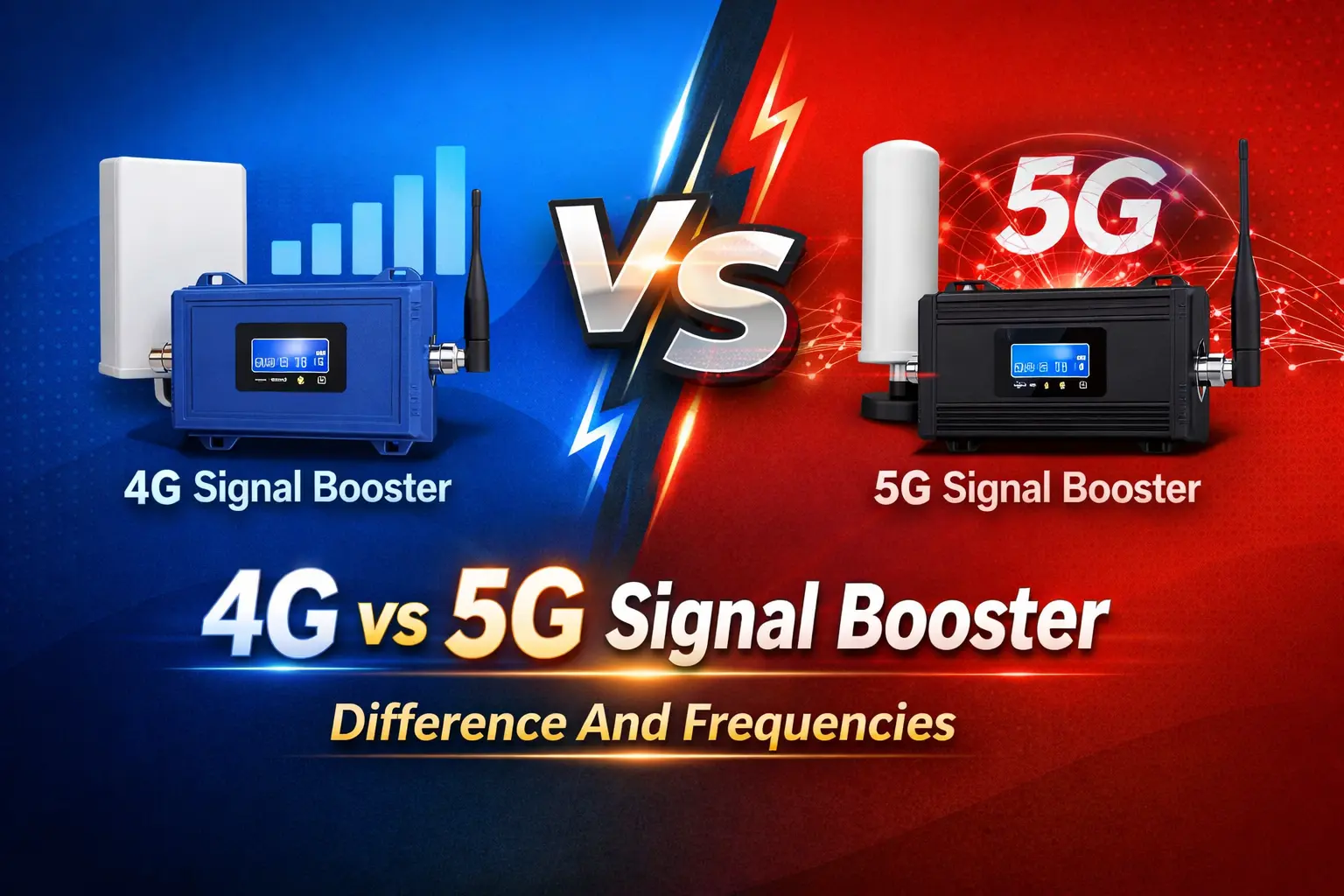
Comparing a 4G-only booster with a 5G model? Our 4G vs 5G signal booster guide explains which one you actually need.
5G Signal Booster Installation in Mumbai, Thane and Mira Road
Mobile Signal Amplifier is based in Mira Road (East) and installs boosters across Mumbai and Thane, including Andheri, Borivali, Malad, Goregaon, Powai and Navi Mumbai.
We check the signal at your location first, confirm which bands your operator uses there, and then recommend the right setup. A home demo is available; the demo charge is waived if you go ahead with the purchase.
You can browse our mobile signal booster for home or read more about mobile signal booster installation in Mumbai.
Frequently Asked Questions
Does a 5G mobile signal booster work with Jio?
Yes, as long as it supports the n78 (3300 MHz) band that Jio True 5G mainly uses. Support for n28 (700 MHz) is a bonus because that band travels through walls better.
Will a 5G booster also improve 4G and calls?
A good multi-band booster boosts both 4G and 5G, so calls, SMS and data all improve. A 5G-only booster may leave 4G calls weak, so check the supported bands.
How much area does one 5G signal booster cover?
A typical home booster covers one flat of about 500–1,500 sq ft with one or two indoor antennas. Actual coverage depends on how strong the outdoor signal is and how many walls the indoor signal has to pass through.
Can I install a 5G mobile signal booster myself?
You can, but most performance problems come from poor antenna placement. The outdoor and indoor antennas need enough distance between them, or the booster cuts its own power. Professional installation avoids this.
Is a mobile signal booster legal in India?
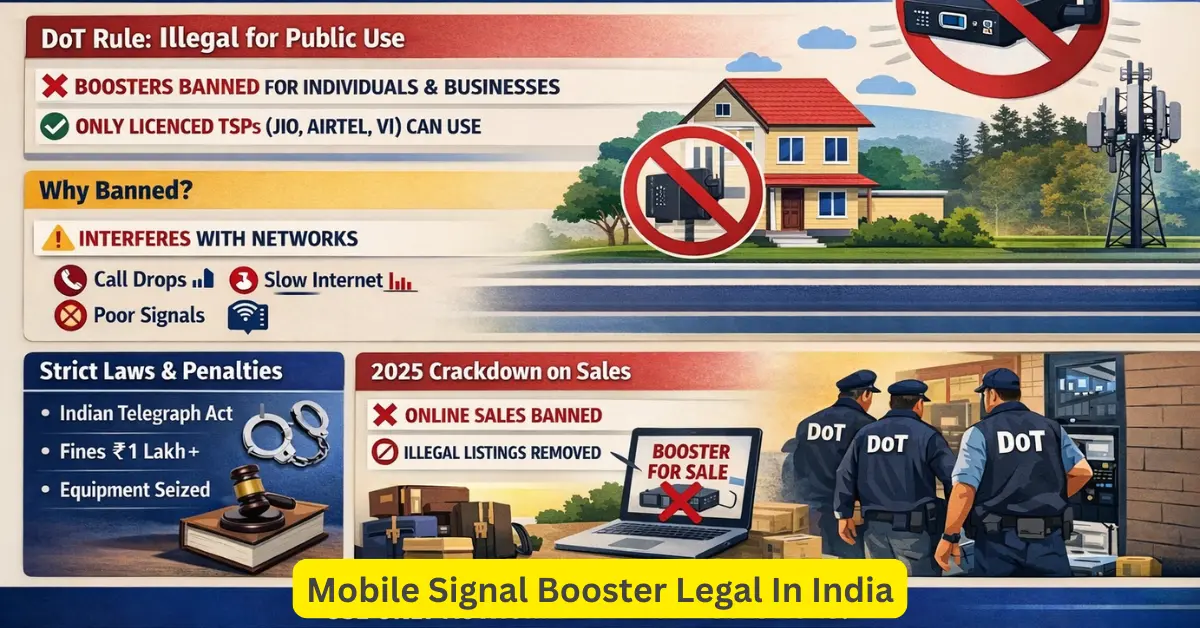
India’s Department of Telecommunications has specific rules about who can sell, install and use boosters. We’ve explained them in plain English in our guide: is a mobile signal booster legal in India?
Get Reliable 5G Coverage at Home
Weak indoor 5G is common across India, especially in high-rise apartments and dense neighbourhoods. The fix starts with three checks: measure your signal, confirm your operator’s bands, and match the booster to your space.
A 5G mobile signal booster for home strengthens the signal you already have. Pick one that supports n78 plus your 4G bands, and get it installed properly.
Need help choosing? Mobile Signal Amplifier helps homes and offices across Mumbai and Thane get stable 4G and 5G coverage. Call +91 97694 03018 or WhatsApp us with your area and network to get started.
Weak 5G at home in Mumbai, Thane or Mira Road?
Tell us your area and network. We’ll recommend the right booster and share a clear price.