
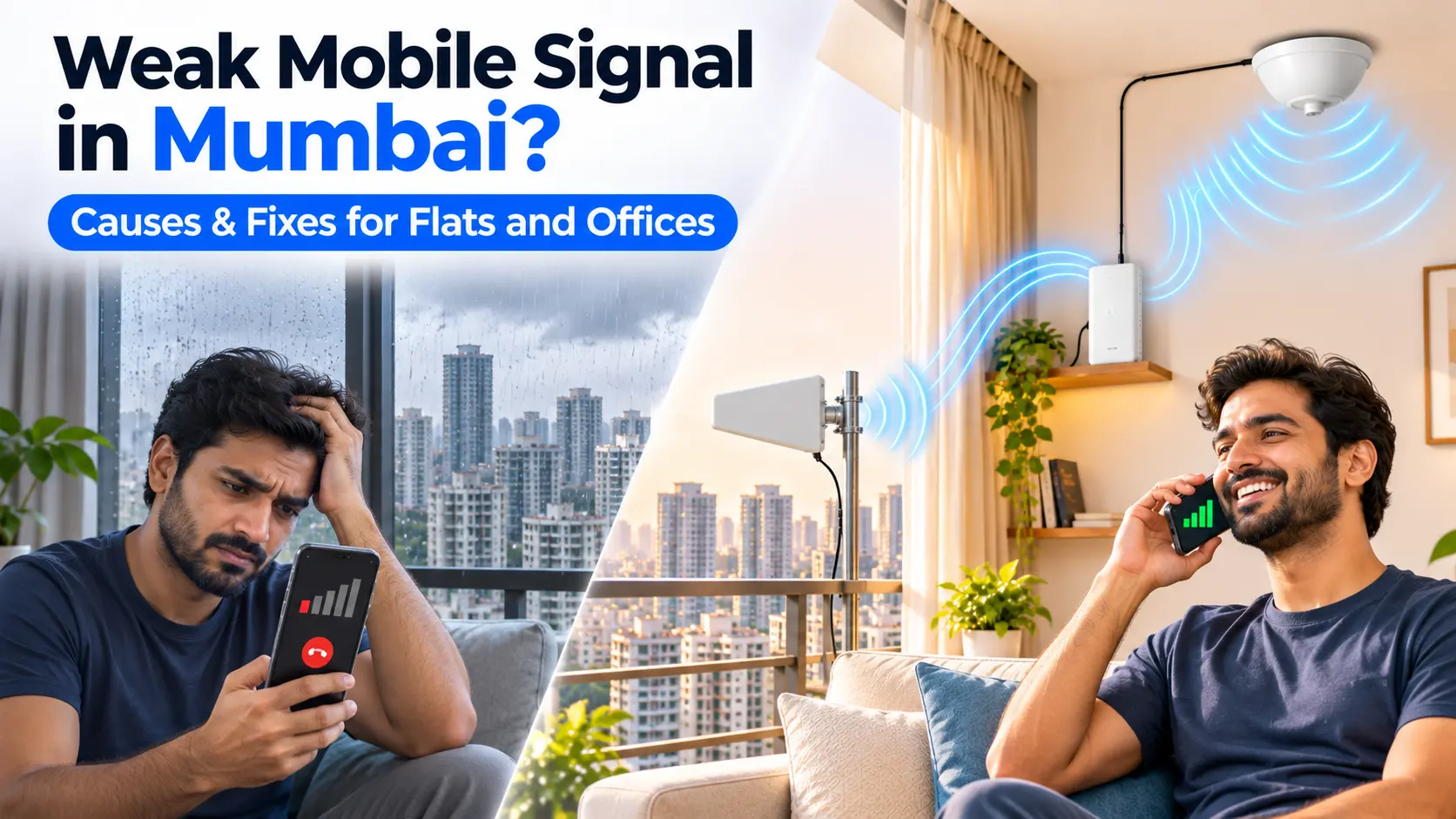
Mobile connectivity in Mumbai is a paradox. The city is packed with cell towers, yet millions of residents and professionals deal with call drops, distorted audio and slow mobile data inside their buildings. Whether you live in a high-rise in Lower Parel or run an office in Andheri, weak mobile signal in Mumbai can disrupt daily calls and work. The good news is that it can almost always be fixed once you know the cause.
This guide explains why indoor coverage fails in Mumbai flats and offices, which areas are worst affected, how a mobile signal booster solves the problem, and what to check before you buy. If you already know you need a booster, see our mobile signal booster in Mumbai page for installation across Mumbai and Thane.
Why Mobile Signal Is Weak in Mumbai Flats and Offices
Weak indoor reception in Mumbai is rarely caused by a complete lack of towers. Instead, building materials, height and dense surroundings stop outdoor signal from getting inside. Knowing these causes makes it easier to choose the right fix.
Building Materials and Signal Loss
Mumbai’s newer residential towers and commercial complexes use heavy concrete, double-glazed windows, metal framing and Low-E (low-emissivity) glass. These improve strength and energy efficiency, but they block radio signals:
- Reinforced Cement Concrete (RCC): Dense concrete walls with steel rebar absorb and block signals, especially the higher-frequency bands used for fast data.
- Glass Facades & Low-E Windows: Tinted or coated glass on corporate towers reflects mobile signals back outside instead of letting them into offices.
- Internal Partitions: In offices, drywall partitions, metal lift shafts and server rooms create dead zones inside an otherwise covered floor.
High-Rise Floors and Pilot Pollution
On higher floors, typically above the 10th or 15th, a problem called “pilot pollution” appears. With nothing blocking the view, your phone picks up signals from several distant towers at once.
Because these signals are of similar strength, the phone keeps trying to switch between towers. This constant switching causes interference, sudden call drops and failed data, even when the phone shows full bars.
Dense Buildings and Signal Shadows
Mumbai’s dense skyline creates “shadow zones”. A 30-storey tower right next to a shorter building can block the line of sight to the nearest cell tower, leaving lower floors and inner rooms of the shorter building with weak signal.
Common Mobile Dead Zones Across Mumbai
Indoor coverage problems affect both older neighbourhoods and new developments. These pockets regularly report poor reception because of building density and layout:
- Lower Parel and Worli: Former mill areas turned into dense high-rise corridors. Glass-fronted office towers and luxury residential towers often have poor coverage on middle and lower floors, and interference on high floors.
- Bandra, Khar and Juhu: A mix of closely packed older buildings and new high-rises near the coast. Ground-floor flats, basement parking and inner rooms away from main roads often lose signal.
- Andheri, Borivali, Mira Road and Bhayandar: Fast-growing western suburbs with large housing societies and commercial complexes. Deep flats, back-facing rooms and lower floors hemmed in by taller buildings commonly struggle with indoor signal.
- Navi Mumbai and Thane: Large townships and industrial parks with wide building footprints. Signal weakens sharply as you move from outer walls to central corridors and office cubicles.
- Basements and Podium Parking: In almost every mall, commercial complex and housing society, underground and podium parking levels block signal completely, cutting off calls and navigation.
How a Mobile Signal Booster Fixes Indoor Coverage
A mobile signal booster (also called a bi-directional amplifier or cellular repeater) bridges the gap between outdoor coverage and indoor spaces. Instead of relying on signal to pass through concrete and glass, it brings the outdoor signal inside through a cable.
Core Components of a Signal Booster System
A standard mobile signal booster installation has four parts:
- Outdoor Donor Antenna: Mounted on the terrace, roof, balcony or outer wall where usable signal exists. Directional antennas (Yagi or log-periodic) target one tower, while omnidirectional antennas pick up signal from all sides.
- Low-Loss Coaxial Cable: Carries the signal from the outdoor antenna to the booster unit with minimal loss.
- Bi-Directional Amplifier (Booster Unit): Strengthens the weak incoming signal and sends it indoors. It also strengthens your phone’s outgoing signal and sends it back to the tower.
- Indoor Service Antenna: Spreads the boosted signal inside. Ceiling domes cover open rooms in all directions, while wall-mounted panel antennas push signal along long corridors or deep office layouts.
Signal Strength vs. Data Speed
A booster improves indoor signal strength (measured in dBm) and call stability by overcoming building losses. It also reduces data drops and buffering.
However, internet speed still depends on the operator’s tower capacity, local congestion, available spectrum and your phone. A booster cannot deliver fast data if the tower itself is overloaded.
Which Network Bands Matter in Mumbai
Each operator uses a different mix of frequency bands, so a booster only helps if it covers the bands your phone uses at your location:
- 850 MHz (Band 5): Jio 4G. A low band that travels far and passes through walls well.
- 900 MHz (Band 8): Airtel and Vi 4G and 2G voice; BSNL 2G.
- 1800 MHz (Band 3): The main 4G and VoLTE band for Jio, Airtel and Vi.
- 2100 MHz (Band 1): 4G for Airtel, Vi and BSNL.
- 2300 MHz (Band 40) & 2500 MHz (Band 41): High-capacity data bands. 2300 MHz is used by Jio, Airtel and Vi; 2500 MHz by Vi. Both lose strength quickly through concrete.
- 5G: Mainly 3500 MHz (n78) for Jio, Airtel and Vi, plus 700 MHz (n28) for Jio. 700 MHz is also used for BSNL 4G.
For a full operator-by-operator breakdown, see our Jio vs Airtel vs Vi vs BSNL band comparison.
Single-Band vs. Multi-Band Boosters
A single-band booster amplifies one frequency (for example 1800 MHz), so it stops helping if your phone switches to another band. Tri-band boosters cover three bands at once, which suits most Mumbai homes. Our All Network kit (900/1800/2100 MHz) suits Airtel, Vi, BSNL and mixed-SIM families, and our Jio kit (850/1800/2300 MHz) suits Jio homes. Both cost ₹12,999.
Note: operators keep changing band use in each area, so always match the booster to the bands active at your location.
Choosing the Right Booster Setup for Your Flat or Office
The right setup depends on floor area, internal walls and outdoor signal strength:
| Property Type | Typical Size | Recommended Setup | Typical Cost |
|---|---|---|---|
| 1 BHK / 2 BHK flat | 500–1,200 sq. ft. | Balcony or window donor antenna + one indoor antenna | ₹12,999 tri-band kit |
| Large flat / penthouse / duplex | 1,500–3,500 sq. ft. | Terrace or outer-wall donor antenna + several indoor ceiling domes | ₹20,000–₹30,000+ |
| Office / commercial suite | 1,000–5,000 sq. ft. | Directional outdoor antenna + splitter and indoor domes | ₹30,000+ after a site survey |
| Basement / underground parking | 3,000+ sq. ft. | High-gain rooftop antenna + high-output booster and panel antennas | ₹30,000+ after a site survey |
For more on picking a home booster, see our best signal booster for home guide.
Installation Tips for Mumbai Flats and Offices
Placement decides how well a booster works. Poorly placed antennas reduce coverage or cause feedback.
1. Find the Best Outdoor Signal Spot
Check signal on your terrace, roof or balcony using your phone’s field test mode or a signal meter. Here’s how to check your signal strength. The outdoor antenna goes at the strongest, cleanest spot, pointed at the nearest tower.
2. Prevent Oscillation (Feedback)
Oscillation happens when the indoor antenna’s signal reaches the outdoor antenna, creating a loop like a microphone held too close to a speaker. Good boosters reduce gain or shut down automatically when this happens.
To prevent oscillation:
- Keep the outdoor and indoor antennas well apart (typically at least 30 feet horizontally or 10–15 feet vertically).
- Use concrete slabs or outer walls to separate the outdoor antenna from the indoor antennas.
- Don’t point the indoor antenna toward the outdoor antenna.
3. Cable Routing and Society Permissions
Housing societies (CHSL) and commercial parks in Mumbai often have rules on outdoor cabling and terrace access, so check with your society office first. Run cables neatly through utility shafts, electrical ducts or window edges, and use good low-loss coaxial cable on longer runs.
Installation is free with our kits. Our team finds the best antenna spot, routes the cable neatly and tests calls and data in every room.
Important Things to Know Before You Buy
You Need Some Signal Outside
A booster is an amplifier, not a signal source. If there is no usable signal on the terrace, balcony or outer walls (0 bars, around -120 dBm or worse), a booster has nothing to amplify.
Avoid Cheap Kits That Cause Interference
Poorly made repeaters without Automatic Gain Control (AGC) or anti-oscillation protection can feed noise back to operator towers and disturb service for your neighbours. To avoid this:
- Choose a booster with built-in AGC that manages output automatically.
- Avoid unbranded kits with no isolation protection.
- Get it installed by someone who checks antenna separation and output levels.
Frequently Asked Questions
1. Can a mobile signal booster work in a flat with no outdoor signal at all?
No. A booster needs existing outdoor signal. It collects the signal outside, amplifies it and spreads it indoors. If there is no usable signal on your balcony, window ledge or terrace, a booster will not work.
2. Will a signal booster increase my 4G or 5G internet speed?
It improves indoor signal strength and stability, which prevents data drops and timeouts. Actual speed still depends on tower capacity, spectrum and congestion. A booster stabilises your connection but cannot fix an overloaded tower.
3. Do I need a single-band or multi-band booster?
If people at home or in the office use different operators, or your operator uses several bands in your area, choose a multi-band (tri-band) booster. Single-band kits only help if your phone always uses that one band.
4. Why does my phone drop calls on high floors even with full signal bars?
This is pilot pollution. On high floors your phone receives similar signals from several distant towers and keeps switching between them, which drops calls. A directional outdoor antenna with a booster locks onto one clear tower and fixes this.
5. Can I install a booster in a rented flat or office?
Yes. Outdoor antennas can be clamped to balcony railings, and thin flat cables can pass through window frames, so drilling can often be avoided. Check with your landlord and society before installing anything outside.
6. Does one booster work for Jio, Airtel, Vi and BSNL?
Only if it covers the bands those operators use at your location. Jio 4G uses 850, 1800 and 2300 MHz, while Airtel, Vi and BSNL rely more on 900, 1800 and 2100 MHz. That is why we offer an All Network kit and a Jio kit.
7. Do you install signal boosters in Mumbai?
Yes. Our team is based in Mira Road and installs across Mumbai and Thane. See our Mumbai signal booster installation page for details.
Conclusion
Weak mobile signal in Mumbai flats and offices usually comes from the building itself: RCC walls, glass facades, high-floor interference and basements. A properly chosen mobile signal booster removes dead zones, stops call drops and restores reliable indoor coverage.
Check your outdoor signal, choose a booster that matches your operator’s bands, and place the antennas correctly to avoid feedback. To assess your flat or office and find the right setup, contact MobileSignalAmplifier.com for professional guidance.
Weak signal at home or work? Call 09769403018 or WhatsApp us. Live demo at your location — free if you buy. Installation is free.