
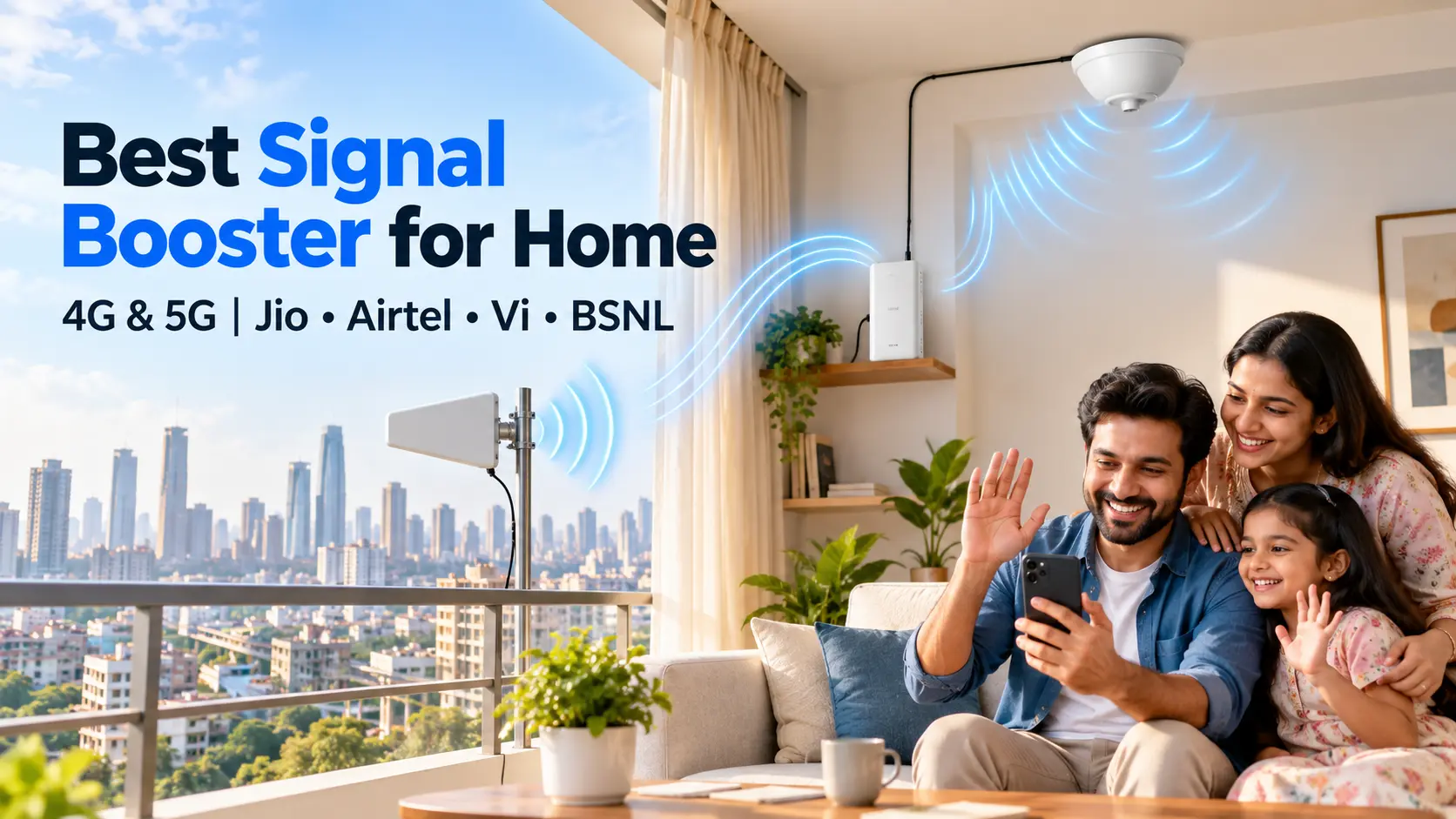
Quick answer: For most Indian homes (1–3 BHK), the best choice is a tri-band booster that covers the bands your operator uses. An all-network 900/1800/2100 MHz kit suits mixed-SIM families, and an 850/1800/2300 MHz kit suits Jio homes. Expect to pay about ₹12,000–₹20,000 for a 4G home kit, ₹12,000–₹30,000 for a 5G-ready booster, and ₹30,000+ for multi-floor homes and basements. A booster only works if there is usable signal outside, on the terrace or balcony.
Weak indoor mobile coverage is a persistent frustration for many homeowners and apartment dwellers across India. Dropped voice calls, distorted audio, and buffering video streams frequently occur even in neighborhoods where outdoor mobile coverage appears strong. When cellular signals struggle to penetrate modern building materials or reach lower floors, installing a dedicated repeater system can resolve these coverage gaps. Finding the best signal booster for home in India requires an understanding of how cellular frequencies operate, evaluating property layout, and assessing the strength of the outdoor signal available at your location.
This guide explains why indoor signal drops occur, outlines the technical differences between single-band and multi-band systems, compares five representative home booster options with realistic price estimates in Indian Rupees (INR), and provides practical advice on choosing and installing a system. Homeowners seeking reliable indoor coverage solutions can explore specialized equipment options through MobileSignalAmplifier.com.
Why Cellular Signal Drops Inside Indian Homes
Indoor cellular connectivity issues rarely stem from a total absence of network infrastructure in the region. Instead, environmental factors and structural barriers attenuate radio frequency (RF) signals between the nearest cellular base station and your mobile device.
Common factors contributing to poor indoor reception include:
- Building Construction Materials: Residential construction in India relies heavily on Reinforced Cement Concrete (RCC), dense brickwork, iron reinforcement bars, and thick plaster. High-density materials absorb and reflect RF signals, dramatically weakening cellular reception as it passes through exterior walls.
- Low-E Glass and Tinted Windows: Modern energy-efficient windows coated with metallic film or Low-E treatment reflect thermal radiation, but they also block high-frequency radio waves, preventing outdoor signals from entering through window openings.
- Distance and Topography: Homes situated far from serving cell towers experience natural free-space path loss. In crowded cities like Mumbai, Thane, Delhi NCR and Bengaluru, dense high-rise structures block direct line-of-sight to the tower, creating signal shadow zones at lower ground levels.
- Frequency Degradation Characteristics: Mobile network operators deploy higher frequency spectrums (such as 1800 MHz, 2100 MHz, and 2300 MHz) to deliver greater data capacity. However, higher frequencies feature shorter wavelengths, which suffer from poorer wall penetration compared to lower frequency bands like 700 MHz, 850 MHz or 900 MHz.
Not sure how weak your signal really is? Check your signal strength in dBm inside the house and on the balcony before you buy anything.
Types of Mobile Signal Boosters: Single-Band vs. Multi-Band
A mobile signal booster system consists of three main hardware components: an outdoor donor antenna, an amplifier unit, and an indoor service antenna connected via low-loss coaxial cabling. Signal boosters are primarily categorized by the number of frequency bands they process simultaneously.
Single-Band Signal Boosters
Single-band boosters amplify a single frequency band, such as 900 MHz or 1800 MHz. These entry-level systems are generally less expensive and are effective when a user only needs to improve service for a single mobile carrier operating on that specific frequency. However, if family members use different network providers or if a carrier relies on multiple frequencies for voice and data, a single-band system may offer limited coverage across all devices.
Dual-Band Signal Boosters
Dual-band boosters process two separate frequency bands simultaneously, such as 900 MHz and 1800 MHz. In India, this combination supports traditional voice services as well as primary 4G LTE network layers across multiple providers. Dual-band systems offer broader carrier compatibility, making them a practical choice for standard small-to-medium apartments.
Tri-Band and Multi-Band Signal Boosters
Tri-band and multi-band boosters amplify three or more frequency bands (for example, 900 MHz, 1800 MHz, and 2100 MHz). These units provide comprehensive indoor coverage because they process multiple mobile standards across different service providers. For households with occupants using different mobile networks, a multi-band system delivers consistent multi-carrier support without requiring separate equipment.
What About 5G?
Most 5G in India runs on the n78 band (3300 MHz). Jio also uses n28 (700 MHz). A 4G booster does not amplify 5G. Your phone simply uses the boosted 4G signal instead, which is usually enough for clear calls and stable data. If you want strong 5G indoors as well, choose a booster that supports n78 plus your operator’s 4G bands. Our 5G mobile signal booster guide explains the bands and prices, and 4G vs 5G signal booster helps you decide whether you need 5G at all.
Top 5 Picks for the Best Signal Booster for Home in India
The best signal booster for home in India depends on your operator’s bands, the size of your home and your budget. The first two picks are kits we sell and install. The other three are setups we recommend for 5G, larger homes and basements, where the price depends on a site check.
1. Mobile Signal Booster for Home – All Network Tri-Band Kit
Best For: 1–3 BHK flats and houses where family members use different SIMs (Airtel, Vi, BSNL and Jio’s 1800 MHz band).
Bands: 900 MHz, 1800 MHz and 2100 MHz (2G, 3G and 4G).
What’s in the kit: Booster unit with Automatic Level Control (ALC), high-gain log-periodic outdoor antenna, indoor antenna and low-loss cable.
Price: ₹12,999 (MRP ₹14,999). View the all-network home kit.
Considerations: Covers 4G calls and data, but not 5G (n78) or Jio’s 850 and 2300 MHz bands.
2. MSB Jio Signal Booster – Tri-Band Kit
Best For: Homes where most people use Jio.
Bands: 850 MHz, 1800 MHz and 2300 MHz, the three bands Jio uses for 4G.
What’s in the kit: Booster unit, outdoor antenna, ceiling indoor antenna and LMR cable.
Price: ₹12,999 (MRP ₹14,999). View the Jio signal booster kit.
Considerations: Built around Jio’s bands. Airtel and Vi users benefit mainly where their network also uses 1800 MHz.
3. 5G-Ready Multi-Band Booster
Best For: Homes where you want strong 5G indoors, not just 4G.
Bands: n78 (3300 MHz) plus your operator’s main 4G bands, and n28 (700 MHz) for Jio where available.
Price: About ₹12,000–₹30,000, depending on bands and coverage.
Considerations: 5G at 3300 MHz loses strength quickly through walls, so antenna placement matters even more. See the 5G booster guide.
4. High-Gain Booster for Large Homes, Duplexes & Villas
Best For: Duplexes, bungalows and independent houses over about 2,500 sq. ft.
Setup: A higher-gain multi-band booster feeding two or more indoor antennas through a splitter, so each floor or wing gets its own antenna.
Price: Usually ₹20,000–₹30,000+, quoted after we check the signal at your property.
Considerations: Needs careful antenna spacing to prevent feedback.
5. Multi-Floor & Basement System
Best For: Basements, home offices and buildings where several floors need coverage.
Setup: Commercial-grade booster with Automatic Gain Control (AGC), longer cable runs and several indoor dome or panel antennas.
Price: Usually ₹30,000+, quoted after a site survey.
Considerations: Needs a planned cable route and a rooftop spot with clean outdoor signal.
A note on cheap single-band kits: Many low-cost boosters sold online amplify only 900 MHz. Jio does not use 900 MHz, so these kits do nothing for Jio SIMs, and they do not improve 4G data on other networks either. Check the bands before you buy.
Comparison of Home Mobile Signal Boosters in India
| Option | Bands | Ideal Home | Price (INR) |
|---|---|---|---|
| All Network Tri-Band Kit | 900 / 1800 / 2100 MHz | 1–3 BHK, mixed SIMs | ₹12,999 |
| Jio Tri-Band Kit | 850 / 1800 / 2300 MHz | 1–3 BHK, mostly Jio | ₹12,999 |
| 5G-Ready Multi-Band | n78 + 4G bands | Homes needing indoor 5G | ₹12,000 – ₹30,000 |
| High-Gain, Multi-Antenna | Multi-band | Duplexes / villas (2,500+ sq. ft.) | ₹20,000 – ₹30,000+ |
| Multi-Floor & Basement | Multi-band, commercial grade | Basements / several floors | ₹30,000+ |
Which bands does your operator use? See our Jio vs Airtel vs Vi vs BSNL band comparison.
How to Choose the Best Signal Booster for Home in India Based on House Size
Property footprint and interior wall composition determine the equipment required for effective indoor coverage. Installing an underpowered device leads to remaining signal dead zones, while improper placement of a high-power unit can cause feedback loops.
- Small Apartments (1 BHK / Single Floor, under 1,000 sq. ft.): A tri-band booster matched to your operator connected to a single outdoor directional antenna and an indoor wall-mounted panel antenna is generally sufficient. Panel antennas broadcast signal forward into primary living spaces.
- Medium Homes (2 BHK to 3 BHK, 1,000 to 2,500 sq. ft.): A tri-band amplifier paired with a ceiling-mounted omnidirectional dome antenna works best for open layouts. If interior brick walls divide the space, running a two-way splitter with two indoor panel antennas directs signal into separate room sections.
- Multi-Story Independent Houses (2,500 sq. ft. and above): Reinforced concrete floor slabs act as severe barriers to radio waves. A multi-story layout typically requires a high-gain booster positioned centrally, with coaxial cables feeding dedicated indoor antennas on each floor level.
- Basements and Underground Workspaces: Basements receive virtually no ambient signal through subterranean walls. A high-gain outdoor donor antenna must be mounted on the roof where clean signal exists, running low-loss coaxial cable down to the basement amplifier and indoor service antenna.
Key Technical Factors and Limitations to Keep in Mind
Before selecting a cellular signal booster, homeowners should understand important technical realities regarding RF amplification:
1. Outdoor Signal Availability is Mandatory: A mobile signal booster is an amplifier, not a signal generator. It requires a usable outdoor signal at the donor antenna location (such as on a rooftop or balcony). If there is zero outdoor cellular signal available, a booster unit cannot create service inside.
2. Signal Strength vs. Signal Quality: Signal strength (measured in dBm) reflects raw signal power, while signal quality (measured in parameters like SINR or RSRQ) determines clarity. Amplifiers boost power levels. However, if the outdoor signal suffers from heavy noise or inter-cell interference, amplifying a poor-quality signal will yield limited improvement.
3. Mobile Data Performance Factors: Improving indoor cellular signal strength can help stabilize connectivity, reduce dropped packets, and prevent frequent network handoffs. However, actual data upload and download speeds depend on broader network conditions, including cell tower backhaul capacity, local operator congestion, and your device’s modem capabilities.
4. Antenna Isolation and System Oscillation: If the indoor antenna and outdoor antenna are placed too close together, amplified indoor signals can loop back into the outdoor donor antenna. This causes oscillation (similar to audio feedback on a microphone). Adequate horizontal or vertical distance must separate the two antennas to ensure stable operation.
What Professional Installation Involves
Most booster problems come from poor installation, not from the booster itself. Here is what our team does on every home installation, so you know what to expect:
- Locate Strongest Outdoor Signal: We measure signal strength (dBm) across different roof or balcony locations. The outdoor donor antenna goes where the strongest, most consistent signal is received.
- Mount Outdoor Antenna Securely: A directional antenna (such as a Log-Periodic or Yagi antenna) is mounted on an elevated pole, pointed toward the nearest serving cell site and fixed firmly so wind cannot move it.
- Route Low-Loss Coaxial Cables: Low-loss coaxial cable runs from the outdoor antenna to the amplifier indoors. We keep cable runs as short and straight as possible to minimize signal attenuation along the line.
- Establish Isolation Distance: We keep enough physical separation—ideally 10 meters horizontally or a solid concrete floor vertically—between the outdoor donor antenna and the indoor service antenna to avoid signal loopback.
- Connect Everything Before Powering On, Then Test: Both antennas are connected before the booster is switched on, because running an amplifier without antennas can damage it. We then check calls and data in each room.
Installation is free with every booster we sell in Mumbai and Thane. Call 09769403018 or WhatsApp us to book a visit.
Frequently Asked Questions (FAQ)
1. Will a home mobile signal booster automatically increase my 4G and 5G internet speeds?
A signal booster stabilizes your mobile link by improving indoor signal strength, which reduces packet loss, lowers latency variance, and stabilizes connection dropouts. However, maximum data throughput depends on cell tower capacity, available bandwidth from your operator, local user congestion, and phone modem specifications.
2. Can a mobile signal booster work if there is no signal outside my house?
No. Boosters rely on capturing an existing outdoor signal via the donor antenna. If there is no usable outdoor signal present on your roof, balcony, or exterior walls, a signal booster cannot generate service indoors.
3. Are home mobile signal boosters safe to operate indoors?
Home boosters transmit at low power, and the indoor antenna is fixed on a wall or ceiling rather than next to where people sit. A side benefit: when indoor signal improves, your phone does not have to transmit as hard to reach the tower, which can help battery life.
4. How do I determine which frequency band my mobile operator uses?
Mobile carriers in India utilize several frequency bands, including 700 MHz, 850 MHz, 900 MHz, 1800 MHz, 2100 MHz and 2300 MHz for 4G, and n78 (3300 MHz) for 5G, depending on the operator and city. Our operator band comparison lists them, and this guide shows how to see which band your phone is using.
5. What is the difference between a directional and an omnidirectional antenna?
A directional antenna (such as a Yagi or Log-Periodic antenna) focuses signal reception in one specific direction, making it effective for pulling in weaker signals from a distant cell tower. An omnidirectional antenna captures signals from all directions, which is suitable for areas with strong ambient signal from multiple surrounding towers.
6. Can a single signal booster support multiple mobile carriers simultaneously?
Yes, provided you choose a multi-band signal booster that supports the specific frequency spectrums deployed by those carriers in your area. Tri-band and multi-band boosters process multiple frequency bands concurrently, allowing users on different mobile networks to receive boosted indoor signal at the same time.
Conclusion
Indoor cellular dead zones do not have to disrupt everyday calls or mobile connectivity at home. By evaluating your local outdoor signal conditions, accounting for internal wall structures, and selecting a booster that matches your operator’s bands and your property size, you can establish reliable cellular coverage throughout your living space.
When searching for the best signal booster for home in India, prioritize frequency compatibility, correct installation geometry, and appropriate coverage specs over raw amplification power. Explore multi-network mobile amplifiers and customized equipment configurations at MobileSignalAmplifier.com to find the optimal solution for your property.
Want help choosing? Call 09769403018 or WhatsApp us. We check the signal at your home in Mumbai or Thane and recommend the right kit. Live demo at your location — free if you buy, and installation is free.