
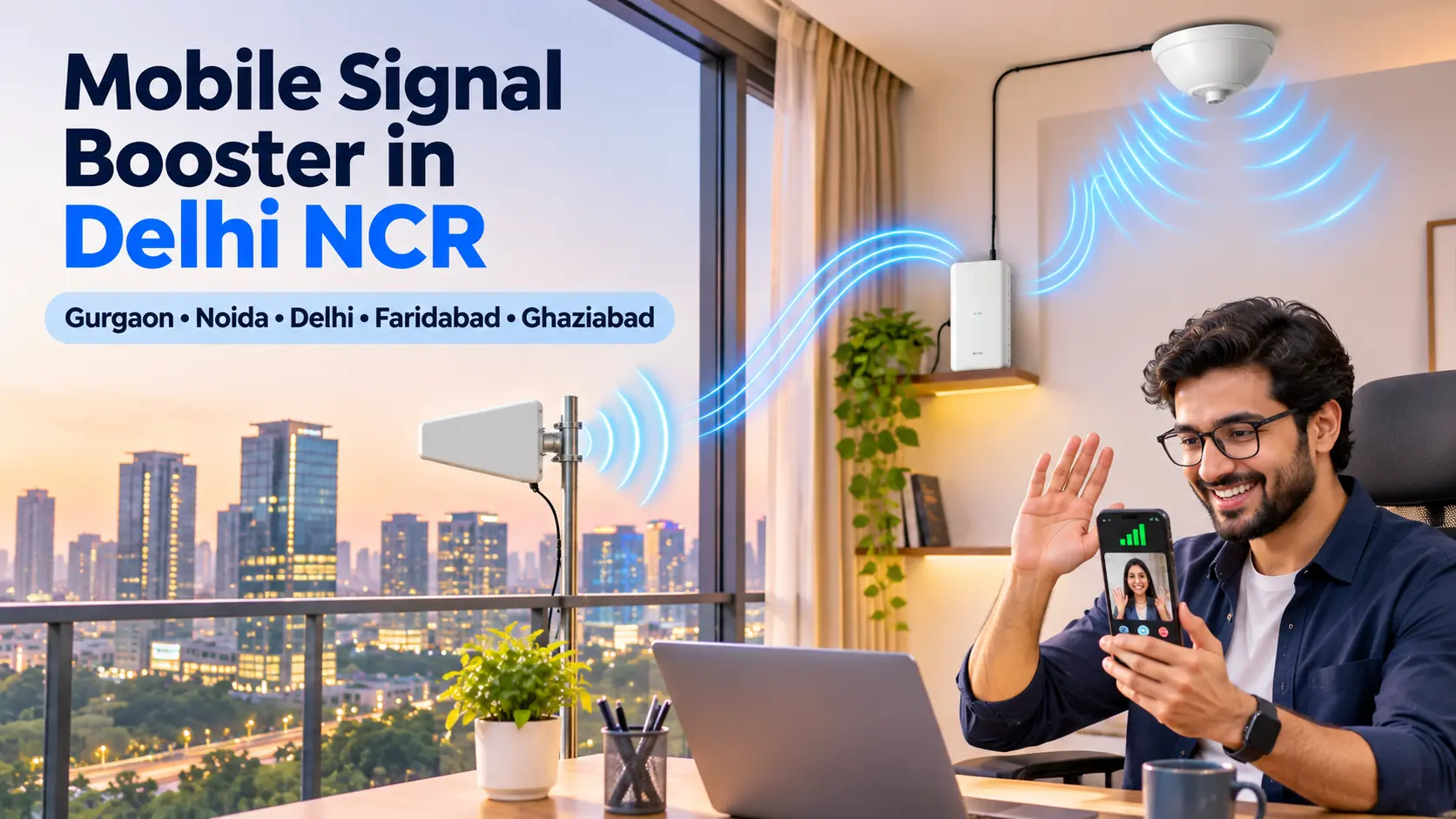
The National Capital Region (NCR), spanning New Delhi, Gurgaon (Gurugram), Noida, Greater Noida, Faridabad and Ghaziabad, is one of India’s fastest-growing urban areas. Despite dense tower coverage and wide 4G and 5G rollouts by Jio, Airtel, Vi and BSNL, indoor mobile reception remains a daily problem for millions of residents and businesses.
Call drops, distorted VoLTE audio, buffering videos and dead zones inside buildings are common complaints across NCR. High-density residential towers, glass-fronted commercial complexes and deep basements block radio signals. This guide explains why these gaps occur, how a mobile signal booster in Delhi NCR works, and which setup suits your home or office.
Why Mobile Signal Fails Across Delhi NCR: Area by Area
Weak indoor signal in NCR is rarely caused by a lack of towers. Instead, dead zones come from building structure, layout and network load, which differ from one sub-city to the next.
Gurgaon (Gurugram): High-Rises and Glass Facades
Gurgaon has tall residential towers along Golf Course Road, Golf Course Extension Road, Sohna Road and Dwarka Expressway, plus large commercial hubs like Cyber City and Udyog Vihar. Signal problems here usually fall into three groups:
- Commercial Glass Facades: Modern office parks use Low-E (low-emissivity) double-glazed glass. Its metallic coating saves energy but reflects mobile signals, keeping them out of office floors.
- High-Rise Interference: Above the 15th floor, phones pick up signals from several distant towers at once. This interference, called pilot pollution, makes the phone keep switching towers and drop calls even with full bars. Lower floors face the opposite problem: surrounding towers block the line of sight to the nearest cell site.
- Basement Parking and Facilities: Deep multi-level basements are almost completely cut off by thick concrete and surrounding soil.
Noida and Greater Noida: High-Density Residential Clusters
Noida (Sectors 74, 75, 76, 78, 137, 150) and Greater Noida West (Noida Extension) have large societies with a dozen or more high-rise towers packed closely together. The main causes of weak signal are:
- Concrete Blockage: Thick concrete pillars, shear walls and dense brickwork weaken signal as it passes through several layers.
- Inner Courtyard Dead Zones: Flats facing inner courtyards or enclosed balconies miss the direct path from towers on the main road.
Faridabad and Ghaziabad: Dense Construction and Industrial Belts
In older, dense areas of Faridabad (such as Sectors 14 and 15 and the Mathura Road industrial corridor) and Ghaziabad (Indirapuram, Vaishali, Raj Nagar Extension):
- Narrow Lanes and Dense Masonry: Multi-storey independent floors built close together block signal from reaching ground floors and inner rooms.
- Metal Structures in Industrial Areas: Large metal sheds, warehouses and factory buildings block signal, weakening calls for offices inside and around them.
Delhi: Colonies, Markets and Basements
In New Delhi, from South Delhi colonies like Hauz Khas, Greater Kailash and Saket to commercial areas like Connaught Place and Karol Bagh, basement offices, underground restaurants and thick old walls block signal. Below ground level, signal rarely gets in without a booster.
Network Bands and Operator Compatibility in Delhi NCR
A booster only helps if it amplifies the frequency bands your operator uses at your location, so it’s worth knowing which bands matter.
Key Frequency Bands Used in India
- Low bands (700, 850, 900 MHz): Travel further and pass through walls better. 850 MHz (Band 5) and 900 MHz (Band 8) carry a lot of indoor 4G and VoLTE traffic. 700 MHz (n28) is used for Jio 5G and BSNL 4G.
- Mid bands (1800, 2100 MHz): 1800 MHz (Band 3) is the main 4G band for Jio, Airtel and Vi. 2100 MHz (Band 1) carries 4G for Airtel, Vi and BSNL.
- High-capacity bands (2300, 2500, 3500 MHz): 2300 MHz (Band 40) adds data capacity in dense areas but passes through walls poorly. 3500 MHz (n78) is the main 5G band.
Which Bands Each Operator Uses
- Jio: 4G on 850 MHz (Band 5), 1800 MHz (Band 3) and 2300 MHz (Band 40); 5G on 3500 MHz (n78) and 700 MHz (n28). Jio has no 2G network, so all calls run as VoLTE.
- Airtel: 4G on 900 MHz (Band 8), 1800 MHz (Band 3), 2100 MHz (Band 1) and 2300 MHz (Band 40); 5G on 3500 MHz (n78).
- Vi: 4G on 900, 1800, 2100 and 2300 MHz, with 2500 MHz in some circles; 5G on 3500 MHz in select cities.
- BSNL: 4G on 2100 MHz and 700 MHz (nationwide since 2025) and 2G on 900 MHz.
This is why one booster does not suit everyone. A single-band 1800 MHz kit improves 4G only when your phone uses 1800 MHz indoors. For Airtel, Vi, BSNL and mixed-SIM homes, a 900/1800/2100 MHz tri-band kit covers the main bands. For Jio, you need 850/1800/2300 MHz, because Jio does not use 900 or 2100 MHz. For a full breakdown, see our Jio vs Airtel vs Vi vs BSNL band comparison.
How a Mobile Signal Booster System Works
A mobile signal booster (also called a cellular amplifier or repeater) does not create signal from nothing. It captures weak outdoor signal from a nearby tower, amplifies it indoors, and sends your phone’s signal back to the tower.
A standard booster kit has four parts:
- Outdoor Donor Antenna: Mounted on the roof, terrace or balcony where usable signal exists. Directional antennas (Yagi or log-periodic) point at one tower; omnidirectional antennas pick up signal from several towers around the building.
- Coaxial Cable: Low-loss cable carries the signal between the outdoor antenna, the booster and the indoor antennas.
- Signal Amplifier (Booster Unit): Placed indoors. It increases the strength (gain, in dB) of the weak signal and passes it to the indoor antennas, and amplifies your phone’s outgoing signal back to the tower.
- Indoor Service Antenna: Spreads the boosted signal inside the home, basement or office. Ceiling domes cover open rooms in all directions; wall panels push signal down long corridors.
Solutions for High-Rise Flats, Basements and Offices
The right setup depends on the layout, height and construction of your property.
1. High-Rise Flats (Gurgaon & Noida)
Start by finding a stable signal spot on your balcony or terrace. For middle and lower floors blocked by nearby towers, a directional outdoor antenna is aimed through a gap between buildings. The indoor antenna then goes in a central room to cover the flat.
2. Basements, Gyms and Underground Parking
Underground spaces usually get no signal at all. The outdoor antenna goes on the roof or an outer wall at ground level, and cable runs down to the basement. Large basements need several indoor dome antennas connected through splitters.
3. Offices and Corporate Parks
Large offices in Gurgaon Cyber City or Noida Sector 62 need higher-power commercial boosters with several indoor antennas to overcome glass walls, metal partitions and false ceilings.
Key Things to Check Before Buying a Booster
- Outdoor Signal: A booster needs usable signal outside, at least 1–2 bars or about -100 to -110 dBm on the roof or balcony. Here’s how to check your signal strength.
- Antenna Separation: If the outdoor and indoor antennas are too close, feedback (oscillation) occurs, like a microphone near a speaker. Keep them well apart, ideally separated by a concrete slab or wall.
- Coverage Area: A home kit typically covers a 1–2 BHK flat, depending on outdoor signal and walls. Villas, offices and warehouses need higher-power boosters with several indoor antennas.
- Speed vs. Signal: A stronger indoor signal steadies VoLTE calls and stops drops, but internet speed still depends on tower capacity and congestion.
Booster Setups by Property Type
| Property Type | Common Problem | Recommended Setup | Bands to Look For | Typical Cost |
|---|---|---|---|---|
| High-rise flat (Noida / Gurgaon) | Blocked by nearby towers on lower floors; tower interference on upper floors. | Balcony or roof directional antenna + indoor antenna. | 900/1800/2100 MHz for Airtel, Vi, BSNL; 850/1800/2300 MHz for Jio. | ₹12,999 tri-band kit |
| Independent house (Faridabad / Ghaziabad) | Thick walls weaken signal between rooms. | Rooftop antenna + splitter with 2–3 indoor antennas. | Tri-band matched to your operator. | Quoted on details |
| Basement office / restaurant (Delhi / Gurgaon) | Almost no signal underground. | High-gain rooftop antenna + long cable run + ceiling domes. | Low bands (850/900 MHz) for reach plus 1800 MHz for VoLTE. | Quoted on details |
| Large office / facility | Glass reflection and large floor areas. | Commercial booster + rooftop antenna + many indoor antennas. | Multi-band coverage for all operators. | Quoted on details |
Getting a Mobile Signal Booster in Delhi NCR
We ship our booster kits across India, including Delhi, Gurgaon, Noida, Faridabad and Ghaziabad. Before you order, our team helps you check your outdoor signal and choose the right kit for your operator. After delivery, we guide you through mounting the antennas, routing the cable and testing every room over phone and WhatsApp video.
- All Network Tri-Band Kit (900/1800/2100 MHz) — ₹12,999: for Airtel, Vi, BSNL and mixed-SIM homes.
- Jio Tri-Band Kit (850/1800/2300 MHz) — ₹12,999: for Jio homes.
For larger houses, basements and offices, share photos and signal readings on WhatsApp and we’ll suggest a setup. Need 5G indoors? See our 5G booster guide. Comparing options? Read our best signal booster for home guide.
Frequently Asked Questions (FAQ)
1. Will a mobile signal booster work if I have zero signal outside my building?
No. A booster needs usable outdoor signal. It captures signal outside and spreads it inside. If there is no signal at all on your roof, terrace or balcony, a booster cannot create it.
2. Can one signal booster support Jio, Airtel and Vi together?
Only if it covers the bands all three use at your location. A 900/1800/2100 MHz kit covers Airtel, Vi and BSNL well, but only Jio’s 1800 MHz band. A Jio 850/1800/2300 MHz kit covers all of Jio’s 4G bands and also helps Airtel and Vi on 1800 and 2300 MHz. For a home with mixed SIMs, choose the kit that matches the operator most people use.
3. Does a mobile signal booster increase internet speed?
Not directly. It improves indoor signal strength and quality, which keeps your connection stable and reduces drops. Actual speed depends on tower capacity, congestion and your phone.
4. Why do I lose signal on high floors in Gurgaon or Noida towers?
On high floors, phones receive similar signals from several distant towers and keep switching between them (pilot pollution). Lower and middle floors are often blocked by nearby tall buildings instead.
5. What is the difference between a directional and an omnidirectional antenna?
A directional antenna (Yagi or log-periodic) focuses on one direction, which suits distant towers or weak signal. An omnidirectional antenna picks up signal from all around, which works best when strong signals come from several towers.
6. Can a signal booster cover a deep basement?
Yes. The outdoor antenna goes on the roof or outer wall, and low-loss cable carries the signal to a booster and indoor antennas in the basement. Large basements need several indoor antennas.
7. Do you deliver signal boosters to Delhi NCR?
Yes. We ship our kits to Delhi, Gurgaon, Noida, Faridabad and Ghaziabad, and guide you through installation over phone and WhatsApp video.
Conclusion
Weak indoor signal across Delhi NCR comes from tall tower clusters, energy-efficient glass, dense masonry and basements. Whether it’s Low-E glass in Gurgaon offices, tower shadowing in Noida societies or basement dead zones in South Delhi, the building usually stops outdoor signal from getting in.
A correctly chosen booster fixes this. Check your outdoor signal, match the kit to your operator’s bands, and place the antennas well apart for clear calls and steady connectivity at home or at work.
Weak signal in Delhi NCR? Call 09769403018 or WhatsApp us. We’ll help you pick the right kit for your operator and guide your installation.