
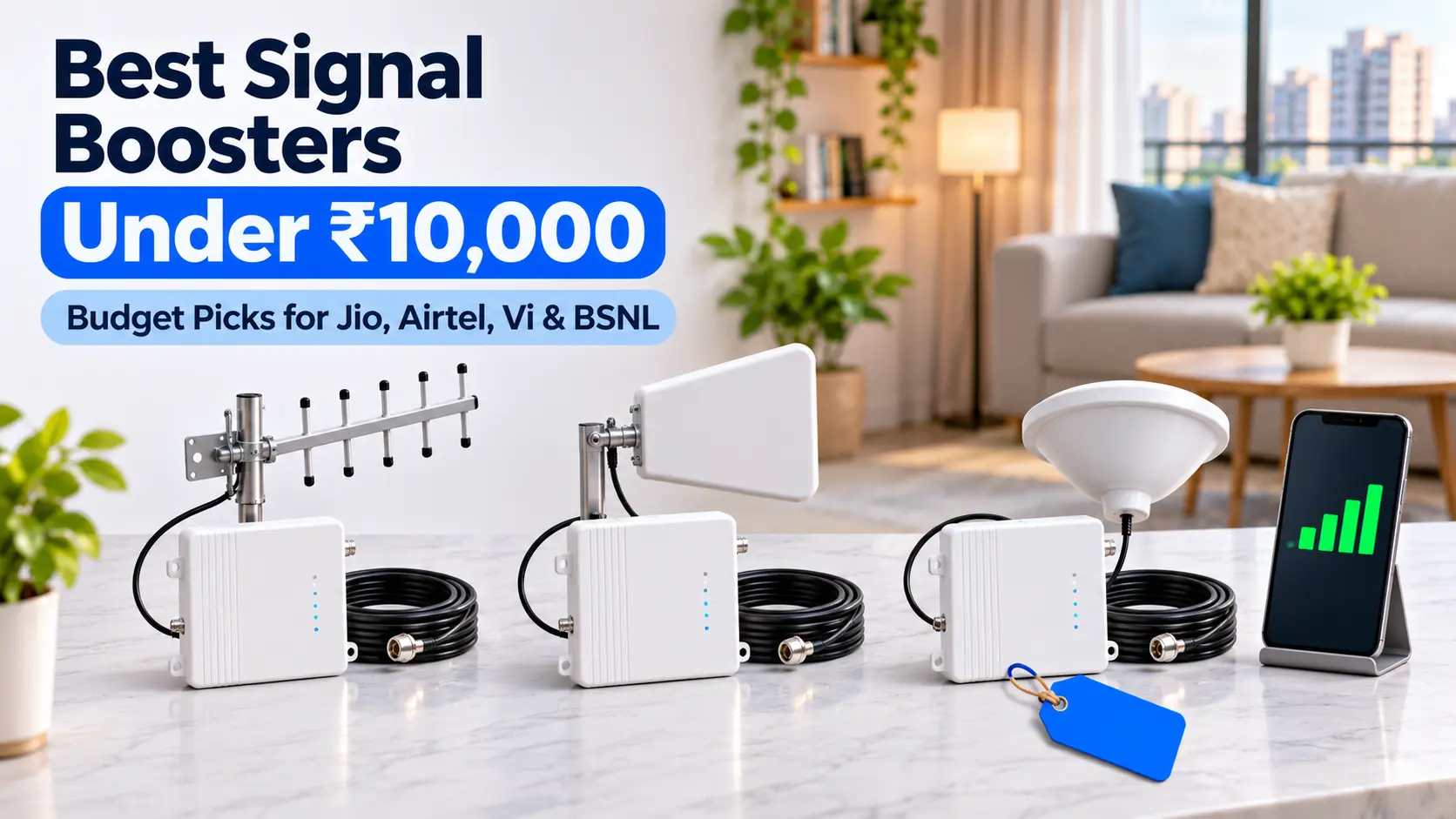
Frequent call drops, delayed messages and buffering videos at home are frustrating. Mobile signals struggle to pass through reinforced concrete walls, tinted glass and metal roofing, so weak indoor reception is a daily problem in many Indian apartments, independent houses and village homes. A well-chosen signal booster under ₹10,000 can fix indoor coverage for a flat or small office without paying for a commercial-grade system.
This guide explains what budget boosters offer, how the main configurations differ, what to realistically expect, and the five best options under ₹10,000 for 2026. Whether you work from a home office, run a small shop or live in a ground-floor flat with poor reception, this will help you pick the right setup.
Understanding the Budget Mobile Signal Booster Market in India
A mobile signal booster (also called a cellular repeater or amplifier) captures an existing outdoor signal, amplifies it, and rebroadcasts the stronger signal indoors. A complete kit has four parts:
- Donor Antenna (Outdoor): Mounted on the roof, balcony or outer wall where usable signal exists, to capture signals from nearby towers.
- Amplifier Unit (Booster): Placed indoors to increase the strength (measured as dB gain) of the received signal.
- Service Antenna (Indoor): Installed inside the room to distribute the amplified signal to phones.
- Coaxial Cable: Connects the outdoor antenna, amplifier and indoor antenna while keeping signal loss low.
In the under-₹10,000 segment, kits focus on essential amplification for small spaces. They do not offer the power or multi-floor coverage of larger systems, but they are a cost-effective fix for 1–2 BHK flats, single rooms and small shops with poor signal penetration.
Budget vs. Premium Signal Boosters: What to Expect
Knowing the difference between a budget kit and a larger booster system helps you set realistic expectations:
| Feature | Budget Kits (Under ₹10,000) | Tri-Band and Larger Systems (₹12,000+) |
|---|---|---|
| Typical gain | 50 dB to 60 dB | 65 dB to 85+ dB |
| Coverage | 300 to 1,200 sq. ft. (room to small flat) | 2,000 to 10,000+ sq. ft. (multi-floor homes, offices) |
| Band support | Mostly single-band or dual-band | Tri-band, multi-band or wideband, including 5G options |
| Gain control | Manual or basic automatic control (varies by model) | Automatic Gain Control (AGC) with auto-shutdown protection |
| Antennas | One outdoor Yagi, panel or omni antenna; one indoor antenna | High-gain directional antennas; several indoor antennas |
5 Best Mobile Signal Booster Options Under ₹10,000
Because each operator uses different frequency bands, the right budget booster depends on your SIM and your location. Under ₹10,000 you are mostly choosing between single-band and dual-band kits, so matching the band matters more than anything else. Here are the five best budget options in India for 2026.
1. Single-Band 1800 MHz (Band 3) 4G Booster
1800 MHz is the one 4G band used by Jio, Airtel and Vi in most telecom circles, so a single-band 1800 MHz kit is the safest low-cost choice for most homes.
- Coverage: About 400–700 sq. ft., depending on outdoor signal.
- Best Use Case: One room, a small flat or a home office with moderate outdoor 4G signal.
- Advantages: Low cost; supports VoLTE calls and basic 4G data on all three private operators.
- Limitations: If your phone uses another band at your location (such as 850, 2100 or 2300 MHz), this booster will not help.
2. Dual-Band (1800 + 2300 MHz) 4G Data Booster
2300 MHz (Band 40) is a major 4G data band for Jio, Airtel and Vi in cities. Pairing it with 1800 MHz covers the two bands most phones use for 4G indoors in urban areas.
- Coverage: About 500–800 sq. ft.
- Best Use Case: City flats where 4G data is the main problem.
- Advantages: Better data speeds than an 1800-only kit; works for Jio, Airtel and Vi.
- Limitations: 2300 MHz fades quickly through walls, and the kit misses Jio’s 850 MHz and the 900/2100 MHz bands used by Airtel, Vi and BSNL.
3. Dual-Band (900 + 1800 MHz) Voice and Data Booster
900 MHz carries voice and 4G for Airtel, Vi and BSNL, and 1800 MHz carries 4G for Jio, Airtel and Vi. Together they cover calls and VoLTE for most non-Jio homes.
- Coverage: About 500–1,000 sq. ft.
- Best Use Case: Small flats or shops on Airtel or Vi.
- Advantages: 900 MHz travels further and passes through walls better; handles voice and VoLTE.
- Limitations: For Jio it only boosts 1800 MHz, and it misses the 2100 MHz band used by Airtel, Vi and BSNL 4G.
4. Single-Band 900 MHz (Band 8) Voice Booster
900 MHz has excellent reach and wall penetration, which makes it a common choice for voice coverage in suburban and semi-urban areas.
- Coverage: About 500–800 sq. ft.
- Best Use Case: Ground-floor flats and village or suburban homes on Airtel, Vi or BSNL where calls are the main need.
- Advantages: Low cost; strong reach in structural dead zones.
- Limitations: Does nothing for Jio, which has no 900 MHz band. Avoid it if anyone at home uses a Jio SIM.
5. Omni-Directional Outdoor Antenna Starter Kit
Instead of a directional Yagi antenna that must be aimed at one tower, these kits use an outdoor antenna that picks up signal from all directions. Check which band the kit supports, as most are single- or dual-band.
- Coverage: About 400–600 sq. ft.
- Best Use Case: Apartment balconies in dense areas with several towers nearby, where aiming a directional antenna is impractical.
- Advantages: Easier to install; no antenna alignment needed.
- Limitations: Lower gain than directional antennas; picks up more noise in busy city areas.
Not sure which bands your operator uses? See our Jio vs Airtel vs Vi vs BSNL band comparison.
Worth Stretching For: Tri-Band Kits at ₹12,999
If none of the single- or dual-band kits match your operator, or your family uses different SIMs, a tri-band kit is worth the extra ₹3,000. Both our kits cost ₹12,999, and installation is free.
- All Network Tri-Band Kit (900/1800/2100 MHz): For Airtel, Vi, BSNL and mixed-SIM homes. Covers 2G, 3G and 4G/VoLTE.
- Jio Tri-Band Kit (850/1800/2300 MHz): Matches all three Jio 4G bands, and also helps Airtel and Vi on 1800 and 2300 MHz.
Need 5G indoors? 5G-ready boosters start around ₹12,000, so they sit above this budget. See our 5G booster guide.
Antenna tip: Directional Yagi or panel antennas give the most gain when aimed at one tower. Omni-directional antennas pick up signal from all sides and are easier to fit on apartment balconies, but have lower gain and pick up more noise in dense cities.
Honest Limitations of Budget Signal Boosters
A budget booster can fix indoor coverage, but realistic expectations prevent disappointment:
1. They Cannot Create Signal from Zero
A booster is an amplifier, not a signal source. If there is no usable signal outside your building (around -115 dBm or worse, or “No Service”), there is nothing to amplify. You need at least 1–2 stable bars on the roof, balcony or outer wall.
2. Limited Coverage Area and Wall Penetration
Budget boosters usually offer roughly 50–60 dB of gain. That suits single rooms, small halls and compact flats. Internal concrete walls, brick partitions and floor slabs weaken the amplified signal quickly, reducing coverage across many rooms.
3. Self-Oscillation and Antenna Isolation Risks
If the outdoor and indoor antennas are too close, the indoor signal leaks back into the outdoor antenna. This feedback loop is called self-oscillation (like a microphone held too close to a speaker). Boosters with Automatic Gain Control (AGC) detect and reduce this; basic units may lose performance or shut down unless the antennas are well separated.
4. Internet Speeds Depend on Network Quality
A stronger indoor signal stabilises the connection, reducing drops and buffering. But a booster does not multiply raw internet speed. Speed still depends on tower capacity, peak-hour congestion, signal quality (SINR/RSRQ) and your phone.
When Should You Consider Spending More?
A booster under ₹10,000 is ideal for smaller homes, but spending more makes sense when:
- Mixed SIMs or Jio Homes: If your family uses different operators, or your Jio phone uses 850 or 2300 MHz indoors, a tri-band kit at ₹12,999 covers far more than any single- or dual-band kit.
- Large Properties: Homes over 1,500 sq. ft., multi-storey houses, duplexes and large offices need more gain and several indoor antennas. See our best signal booster for home guide for options up to ₹30,000+.
- Very Weak Outdoor Signal: Where outdoor signal is 1 bar or less, a basic 50–60 dB unit may not have enough gain to cover the inside.
- Commercial Buildings: Warehouses, basements, hospitals, hotels and multi-tenant buildings need professionally designed coverage solutions like those from MobileSignalAmplifier.com.
Essential Pre-Purchase Checklist for Indian Buyers
Before buying a budget booster, run these checks:
- Measure Outdoor Signal Strength: Take your phone to the roof, balcony or an outside window and check that calls and web pages work there. You can read exact signal levels in dBm (between -70 and -95 dBm is workable). Here’s how to check your signal strength.
- Identify Your Operator’s Bands: Jio 4G uses 850, 1800 and 2300 MHz. Airtel uses 900, 1800, 2100 and 2300 MHz. Vi uses 900, 1800, 2100, 2300 and 2500 MHz. BSNL 4G uses 2100 and 700 MHz, with 2G on 900 MHz. Pick a kit that matches the bands at your location.
- Plan Antenna Separation: Leave at least 10–15 feet vertically (or about 30 feet horizontally with a solid wall in between) between the outdoor and indoor antennas to prevent oscillation.
- Check the Cable Route: Most kits include 10–15 metres of coaxial cable. Measure from the outdoor mounting point to the indoor spot and avoid sharp bends or extra joints, which add signal loss.
Frequently Asked Questions
1. Will a signal booster under ₹10,000 increase my internet speed?
It improves indoor signal strength and stability, which reduces buffering and drops caused by poor coverage. Actual speed still depends on tower capacity, congestion and signal quality at your location.
2. Can a budget mobile signal booster work if I have no signal outside?
No. A booster needs usable outdoor signal. If there is no signal on your roof, balcony or outside wall, there is nothing to boost indoors.
3. Which frequency band is best for mobile voice calls in India?
Most calls today are VoLTE over 4G, carried widely on 1800 MHz (Band 3) and other 4G bands. Airtel, Vi and BSNL also use 900 MHz (Band 8) for 2G voice and coverage. Check your operator’s active band at your location before buying a single-band kit.
4. How far apart should the indoor and outdoor antennas be installed?
Keep at least 10–15 feet vertically (for example, donor antenna on the roof and service antenna in a room below) or about 30 feet horizontally with solid walls between them.
5. Do budget mobile signal boosters work with all telecom operators in India?
A booster amplifies frequencies, not brands. If a kit supports 1800 MHz, it boosts any operator broadcasting on 1800 MHz at your location. Jio needs 850/1800/2300 MHz, while Airtel, Vi and BSNL rely more on 900/1800/2100 MHz, which is why we offer two tri-band kits.
6. Can I install a budget signal booster kit by myself?
You can, but results depend on placement: the outdoor antenna has to be aimed at the right tower and kept far enough from the indoor antenna. Installation is free with our kits — our team mounts and aims the antennas, routes the cable neatly and tests calls and data in every room.
Conclusion
A mobile signal booster under ₹10,000 is a practical way to fix indoor dead zones, clear up muffled calls and keep a steady connection in small homes, flats and home offices. Match the kit to your operator’s bands, confirm there is usable signal outside, and keep the antennas well separated for reliable coverage indoors.
For multi-storey homes, basements or large commercial spaces, talk to the experts at MobileSignalAmplifier.com for a site assessment and the right coverage solution.
Not sure which kit fits your home? Call 09769403018 or WhatsApp us. Live demo at your location — free if you buy. Installation is free.