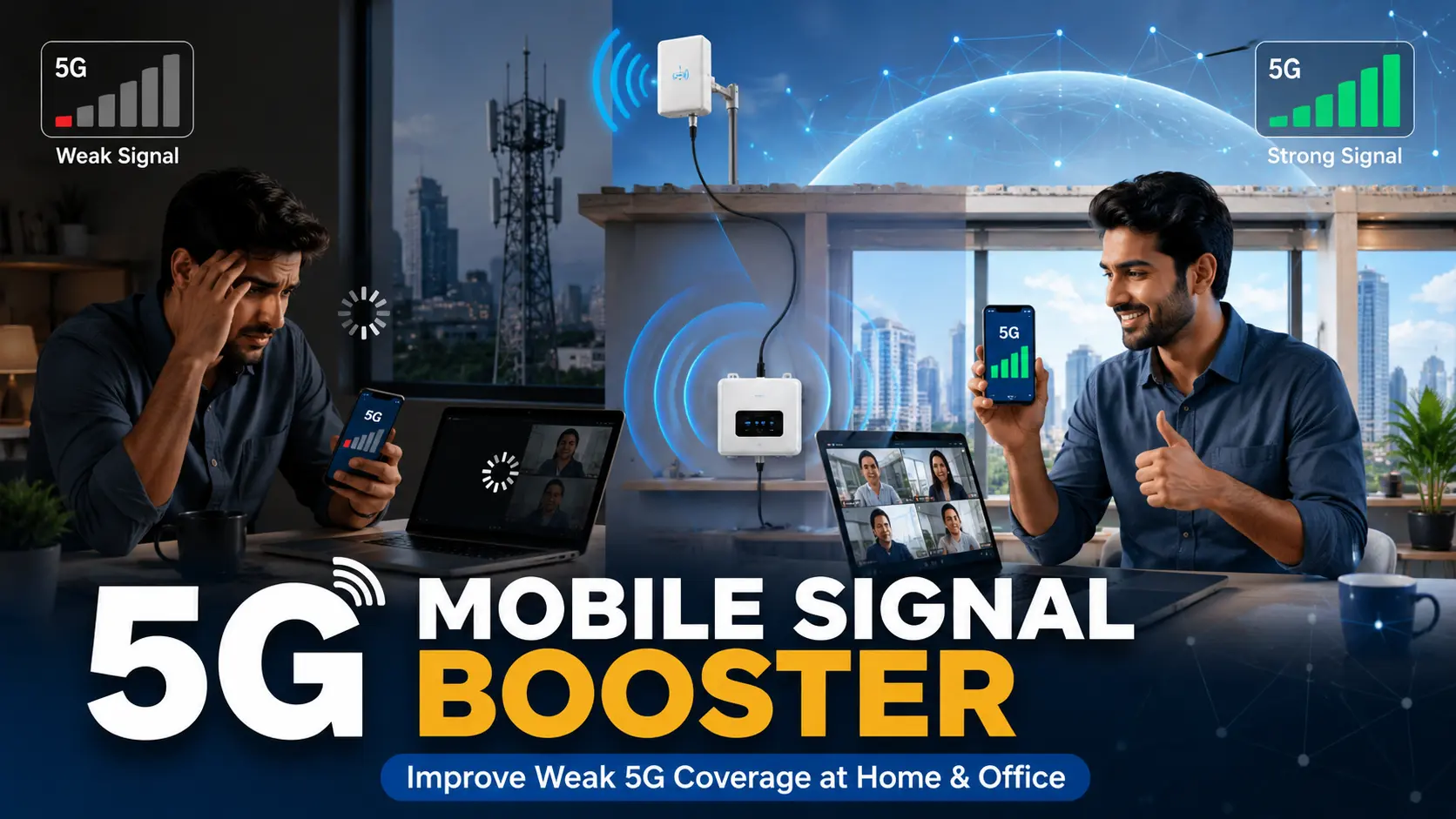
You’re in the middle of an important call — and it drops. Again.
You’re living in a high-rise in Andheri, working from a basement office in Bandra, or running a business from Navi Mumbai — and your phone shows one bar no matter what network you use. You’re not imagining it. And no, it’s not your SIM card.
Mumbai’s dense construction, thick concrete walls, and packed urban infrastructure block mobile signals more than almost any other city in India. The good news? A mobile signal booster can fix this — completely and permanently.
But here’s the problem: most people buy the wrong booster. They pick the first result they see online, it doesn’t work, and they’re stuck with a useless device.
This guide will help you avoid that mistake. Follow these four steps to choose the right mobile signal booster for your area, your network, and your space in Mumbai.
Why Is Your Mobile Signal Weak in Mumbai?
Before you buy anything, it helps to understand why your signal is weak. The problem usually isn’t your network provider — it’s your environment.
Thick Concrete Walls in High-Rise Buildings
Most apartments in Mumbai — especially in Andheri West, Borivali, Malad, and Powai — are built with thick reinforced concrete. Cell tower signals struggle to penetrate these walls. The higher your floor, the more floors of concrete the signal has to fight through before it reaches you.
Basement Parking, Underground Offices, and Dead Zones
Signal strength drops dramatically underground. If you’re in a basement office in Worli, a parking garage in Dadar, or a server room in Lower Parel — you’re in a radio frequency dead zone. No amount of “switching to a different network” will help here.
New Construction in Navi Mumbai and Thane
Rapidly developing areas like Thane, Kharghar, and Panvel have new residential towers going up faster than cell tower infrastructure can keep up. Your building may simply be too far from the nearest active tower — or blocked by newer buildings around it.
Understanding your specific situation will help you pick the right booster for your exact Mumbai location.
Understanding dBm — What Your Signal Strength Actually Means
Most people look at the signal bars on their phone and think that’s enough. It’s not. Those bars are just a visual shortcut — and every phone brand displays them differently. The real measure of signal strength is dBm (decibel-milliwatts), and understanding it will help you choose a booster with the right power level for your situation.
What Is dBm and Why Does It Matter?
dBm measures the actual power of the signal your phone is receiving from the cell tower. It’s always a negative number — the closer to zero, the stronger your signal.
Here’s a simple reference chart for Mumbai:
| dBm Range | Signal Quality | What It Means in Mumbai |
|---|---|---|
| -50 to -70 dBm | Excellent | You’re near a tower — likely an open terrace or ground floor |
| -70 to -85 dBm | Good | Typical signal in most well-located Mumbai apartments |
| -85 to -100 dBm | Weak | Common inside high-rise interiors, behind thick concrete walls |
| -100 to -110 dBm | Very Weak | Basements, deep interior rooms, areas far from towers |
| Below -110 dBm | No Signal | Dead zones — underground parking, server rooms, remote areas |
How to Check Your dBm in Mumbai
On Android: Go to Settings → About Phone → SIM Status → Signal Strength. You’ll see a number like “-97 dBm” — that’s your real signal.
On iPhone: Dial *3001#12345#* and tap Call to open Field Test mode. Your dBm reading will appear in the top-left corner (or in the dashboard on newer iPhones).
Why dBm Matters When Choosing a Mobile Signal Booster
A booster’s job is to take that weak outdoor signal and amplify it indoors. If your outdoor signal is -85 dBm or stronger, even a mid-range booster will work beautifully. But if your outdoor reading is below -100 dBm — as is common in deep basement offices in Dadar or lower floors of densely packed buildings in Dharavi — you’ll need a high-gain booster of 65 dB or more to compensate.
Always check your outdoor dBm before buying. It determines exactly how powerful a booster you need.
Step 1 — Identify Your Network and Frequency Bands
This is the single most important step. A signal booster only works if it supports the frequency band your carrier uses in your area. Here’s a full breakdown of every major network operating in Mumbai.
Complete Frequency Band Reference Table — Mumbai (2026)
| Network | Technology | Band Number | Frequency | Use |
|---|---|---|---|---|
| Jio | 4G LTE | Band 5 | 850 MHz | Primary 4G (best indoor coverage) |
| 4G LTE | Band 3 | 1800 MHz | Secondary 4G | |
| 5G NR | n28 | 700 MHz | 5G (strong indoor penetration) | |
| 5G NR | n78 | 3500 MHz | 5G (high speed, shorter range) | |
| Airtel | 4G LTE | Band 3 | 1800 MHz | Primary 4G |
| 4G LTE | Band 1 | 2100 MHz | Secondary 4G (urban areas) | |
| 4G LTE | Band 40 | 2300 MHz | High-capacity 4G (dense zones) | |
| 5G NR | n78 | 3500 MHz | 5G (Mumbai metro areas) | |
| Vi (Vodafone Idea) | 2G/3G | Band 8 | 900 MHz | Voice + 3G fallback |
| 4G LTE | Band 3 | 1800 MHz | Primary 4G | |
| 4G LTE | Band 1 | 2100 MHz | Secondary 4G | |
| BSNL | 2G/3G | Band 8 | 900 MHz | Voice + data (suburban Mumbai) |
| 4G LTE | Band 28 | 700 MHz | 4G (expanding in Mumbai) | |
| 3G | Band 1 | 2100 MHz | 3G data |
Lower frequency bands (700–900 MHz) penetrate thick concrete walls and travel farther — ideal for high-rise apartments and basements. Higher frequency bands (1800–3500 MHz) carry more data but have shorter range and weaker wall penetration. If you’re in a deep interior flat in Borivali or a basement in Bandra, prioritise a booster that supports the lower-frequency bands of your network.
Jio Frequency Bands in Mumbai
Jio is the strongest network for indoor use in Mumbai because of its Band 5 (850 MHz) — a low-frequency band that cuts through concrete easily. For 5G, Jio’s n28 (700 MHz) is also excellent for penetrating walls, while n78 (3500 MHz) delivers fast speeds but needs a clear line of sight. If you’re a Jio user, your booster must support Band 5 at minimum.
Airtel Frequency Bands in Mumbai
Airtel relies primarily on Band 3 (1800 MHz) and has strong coverage in Mumbai’s commercial zones — Andheri East, BKC, Nariman Point. For 5G, Airtel uses n78 (3500 MHz). In high-rise residential areas like Malad and Kandivali, Airtel signal can drop significantly indoors — a booster supporting 1800 MHz will make an immediate difference.
Vi (Vodafone Idea) Frequency Bands in Mumbai
Vi uses Band 3 (1800 MHz) as its primary 4G band, with Band 8 (900 MHz) for voice and 3G fallback in suburban Mumbai areas. Vi’s 5G rollout in Mumbai is more limited compared to Jio and Airtel. For Vi users in areas like Thane, Navi Mumbai, or older parts of Kurla, a dual-band booster covering 900 MHz + 1800 MHz gives the most complete coverage.
BSNL Frequency Bands in Mumbai
BSNL uses Band 8 (900 MHz) for voice and older data services, and is actively rolling out Band 28 (700 MHz) for 4G across Mumbai’s suburban areas — Virar, Vasai, and parts of Thane. If you’re on BSNL and living in a suburban Mumbai locality, look for a booster that explicitly supports 700 MHz or 900 MHz.
How to Check Which Band Your Phone Is Using
On Android, dial *#*#4636#*#* and tap “Phone Information.” Scroll down to find your current network band. On iPhones, you’ll need a third-party field test app. Knowing your active band helps you buy a booster that’s 100% compatible — not one that supports 12 bands but misses yours.
Step 2 — Measure Your Coverage Area
The second factor is coverage. Boosters are rated for specific square footage — and buying too small is a common and expensive mistake.
Small Homes and Apartments (Up to 1,000 sq ft)
A 1–2 BHK flat in Chembur, Kurla, or Goregaon typically falls in this range. A single-unit residential booster with coverage up to 1,000 sq ft is sufficient. Look for models with 50–60 dB gain.
Medium Offices and Floors (1,000–3,000 sq ft)
This covers most small offices, co-working spaces, clinics, and 3–4 BHK apartments in areas like Juhu, Powai, or Bandra. You’ll need a mid-range booster with a stronger internal antenna and at least 60 dB gain to cover the full area evenly.
Large Commercial Spaces and Buildings (3,000–5,000+ sq ft)
Larger offices, retail stores, hotels, and multi-floor buildings — common in Andheri East, BKC, and Nariman Point — need commercial-grade boosters with gain of 65–70+ dB and multiple internal antennas to distribute signal evenly across all zones.
Always overestimate your coverage area by at least 20%. Walls, furniture, and glass partitions reduce effective signal distribution. A booster rated for 2,000 sq ft in open space may only cover 1,500 sq ft in a real apartment.
Step 3 — Choose the Right Type of Signal Booster
Not all boosters are the same. Once you know your band and coverage area, you need to choose the right type. There are four main categories — and picking the wrong one is the second biggest mistake buyers make.
Single-Band Boosters
A single-band booster amplifies exactly one frequency band — for example, only 1800 MHz (Band 3). It’s the most affordable option and works perfectly if your entire household uses one network on one band.
Best for: A small 1 BHK flat in Chembur or Goregaon where everyone is on Jio and uses Band 5 only. Budget-conscious buyers with a very specific, predictable network setup.
Limitation: Useless for anyone on a different network or if your carrier switches bands in your area.
Dual-Band Boosters
A dual-band booster supports two frequency bands simultaneously — the most popular combination in Mumbai is 900 MHz + 1800 MHz, which covers both Vi’s voice/3G fallback and its 4G band in a single device.
Best for: Homes where two people are on the same carrier but using different technologies (e.g., one on 3G, one on 4G), or Vi/BSNL users who need 900 MHz + 1800 MHz covered.
Common combo: 850 MHz + 1800 MHz — covers Jio’s two main 4G bands. Excellent for Jio-only households.
Tri-Band Boosters
A tri-band booster covers three bands — typically 900 MHz + 1800 MHz + 2100 MHz. This is where it starts getting versatile. This combination covers voice, 3G, and 4G for most Indian networks simultaneously.
Best for: Mixed-network Mumbai households — say, one person on Vi and another on Airtel. Also great for small offices in Andheri or Bandra with 5–10 employees on different carriers.
Why it’s popular: One device replaces three single-band boosters. More cost-effective for mixed-use environments.
Quad-Band (Multi-Band / Wideband) Boosters
A quad-band or multi-band booster supports four or more frequency bands at once — often covering 700 MHz + 850 MHz + 1800 MHz + 2100 MHz, and sometimes 2300 MHz or 2600 MHz as well.
Best for: Offices, co-working spaces, clinics, hotels, and large Mumbai apartments where employees or residents use Jio, Airtel, Vi, and BSNL all at once. Also the right choice if you want to future-proof your setup as networks evolve.
The Mumbai recommendation: For most homes and offices in Mumbai with mixed networks, a quad-band booster is the smartest investment. It costs more upfront but eliminates every compatibility issue — you won’t need to replace it when a family member changes carriers.
Mobile Signal Booster Types at a Glance
| Type | Bands Supported | Best For | Approx. Cost Range |
|---|---|---|---|
| Single-Band | 1 band | Same network, same band, all users | ₹8999–₹12999 |
| Dual-Band | 2 bands | One carrier, 3G + 4G coverage | ₹9999–₹15,000 |
| Tri-Band | 3 bands | Mixed carriers, home/small office | ₹12,000–₹22,000 |
| Quad-Band / Multi-Band | 4+ bands | Offices, large homes, future-proof | ₹18,000–₹40,000+ |
💡 For Mumbai Users: With Jio, Airtel, and Vi all using different band combinations — and BSNL still active in suburban Mumbai — a tri-band or quad-band booster is the safe, smart default for any shared space in the city.
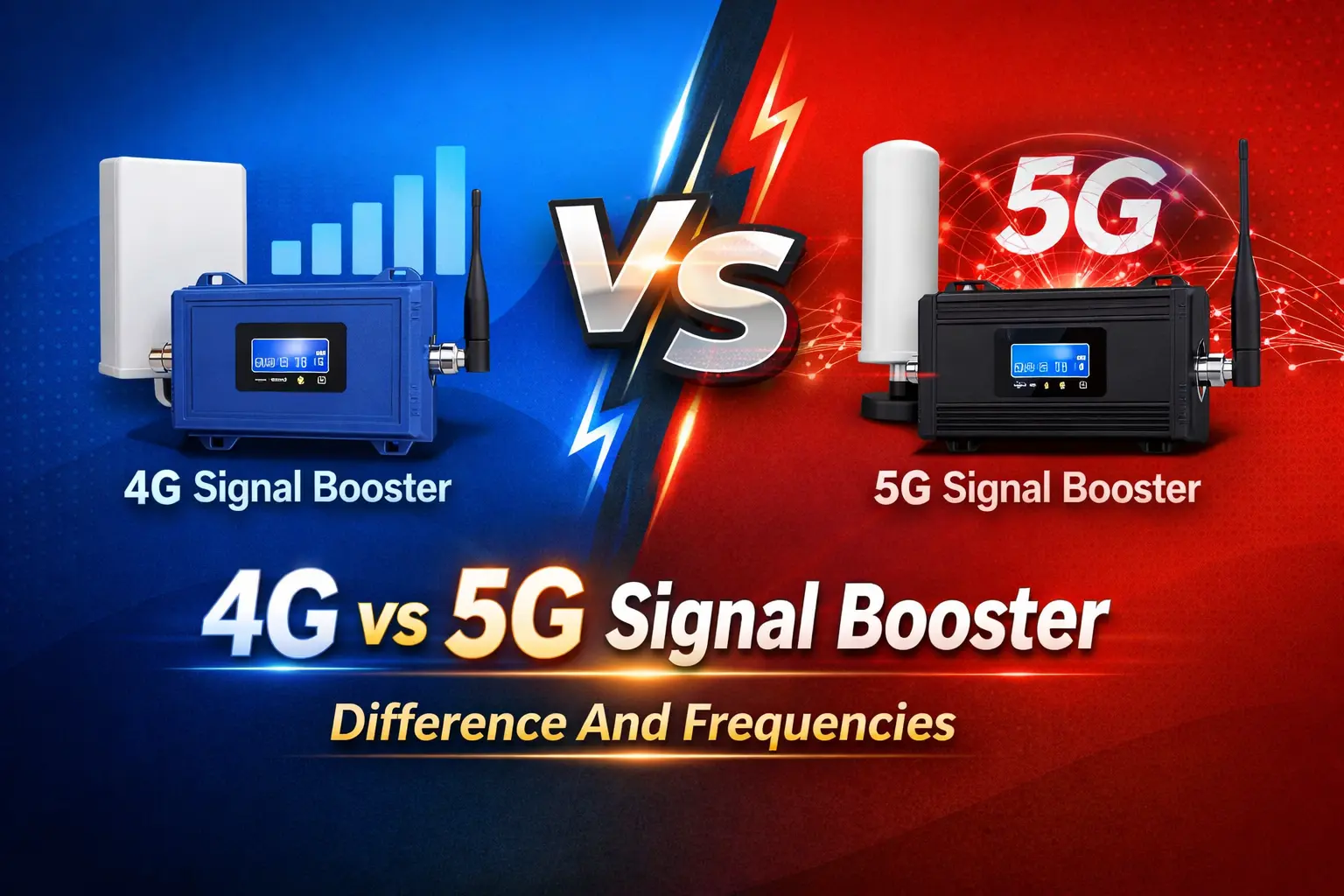
4G Booster vs. 5G Booster — What’s Right for You?
If your area already has active 5G coverage from Jio or Airtel (most of Mumbai does in 2026), a 5G-ready booster is worth the investment. It supports both 4G LTE and 5G bands, so you’re covered today and future-proof for tomorrow.
If you’re in an area where 5G coverage is still limited — like some parts of Thane or Navi Mumbai’s newer sectors — a high-quality 4G booster will serve you well right now, at a lower price point.
Step 4 — Check These Key Specs Before You Buy
Once you’ve narrowed down your type and coverage, look at these technical specs to make your final decision.
Gain (dB) — The Most Important Number
Gain is measured in decibels (dB) and tells you how much amplification the booster provides. Higher gain = stronger signal boost.
- 50–60 dB: Good for urban areas with moderate outdoor signal (most Mumbai localities)
- 60–70 dB: Ideal for weak zones — basements, thick-walled buildings, interior rooms
- 70+ dB: Commercial-grade, for large spaces with very poor signal
Don’t buy based on price alone. A cheap 45 dB booster won’t solve a severe signal problem in a basement flat in Dadar.
Auto Gain Control (AGC) — Why It Matters
AGC is a smart feature that automatically adjusts signal amplification based on how strong or weak the outdoor signal is. Without AGC, a booster can over-amplify signals and actually cause interference — which can get flagged by your carrier.
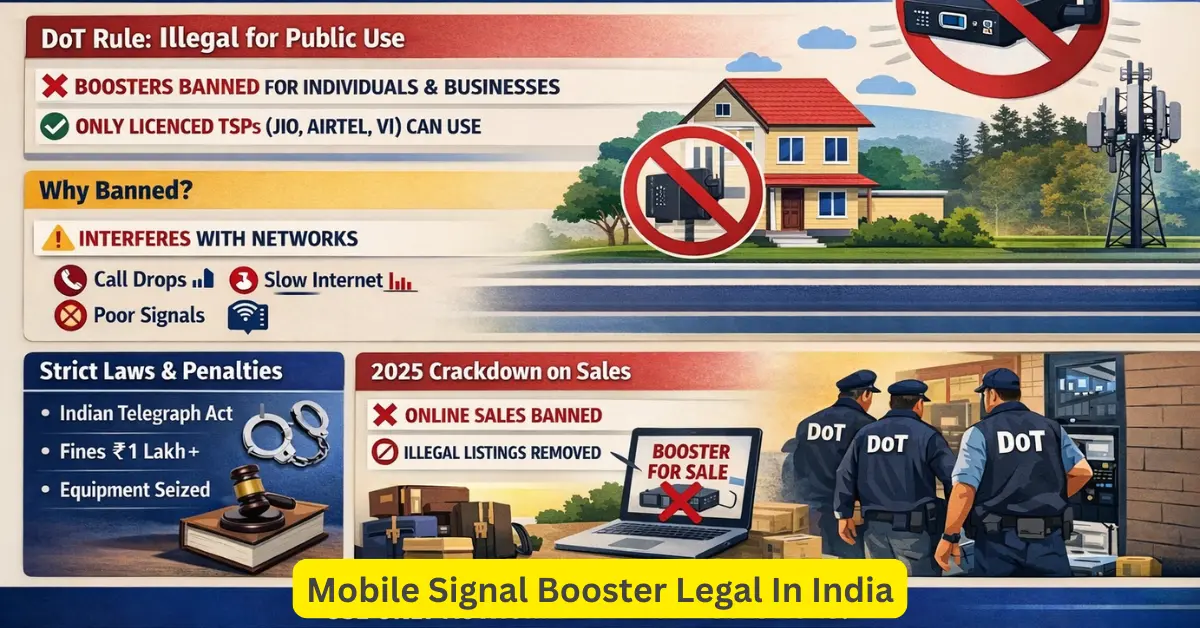
Always choose a booster with AGC built in. It protects your network, your neighbours’ networks, and ensures your booster operates within DoT-approved limits.
DoT Certification — Non-Negotiable
In India, signal boosters must be certified by the Department of Telecommunications (DoT) and comply with TEC (Telecommunications Engineering Centre) standards. Using an uncertified booster is illegal and can result in penalties. Always ask for the DoT certification number before purchasing.
Outdoor vs. Indoor Antenna Placement
Every signal booster has two antennas: an outdoor (donor) antenna that captures signal from the cell tower, and an indoor (server) antenna that distributes the boosted signal inside your space.
For high-rise apartments in Mumbai, the outdoor antenna is typically mounted on the terrace or external wall. Proper placement is critical — a poorly positioned outdoor antenna is the #1 reason boosters underperform. Always use a professional installer who knows Mumbai building layouts.
How to Choose the Right Mobile Signal Booster FAQs
Which Signal Booster Works Best for Jio in Mumbai?
Jio uses Band 5 (850 MHz) for 4G in most of Mumbai. Look for a booster that specifically supports 850 MHz LTE. For Jio 5G users, ensure the booster is n78 or n28 compatible. A multi-band booster that covers both 850 MHz and 1800 MHz will work for Jio across all Mumbai localities — including areas where Jio switches between bands.
Can One Booster Support Multiple Networks in My Flat?
Yes — but only if it’s a multi-band or wideband booster. A good multi-band booster will simultaneously amplify Jio, Airtel, and Vi signals without any interference between networks. This is the ideal solution for families or offices where different people use different carriers.
How Is a Signal Booster Installed in a Mumbai Apartment?
Installation is a two-part process: the outdoor antenna is mounted on your building’s rooftop or external wall (with housing society permission if required), and the indoor antenna is placed in the area where you need signal. A coaxial cable connects the two. Professional installation typically takes 2–4 hours for a standard apartment. Mobile Signal Amplifier offers expert installation across Mumbai — from Andheri to Navi Mumbai.
📞 Ready to book? Call or WhatsApp us today for Mumbai installation — same-week appointments available.
What Is the Mobile Signal Booster Price in Mumbai?
Prices vary based on coverage area and network type. A residential 4G booster for a 1–2 BHK starts from around ₹8,000–₹15,000 (installation included). Mid-range office solutions for 2,000–3,000 sq ft range from ₹15,000–₹30,000. Commercial-grade installations for large offices or multi-floor buildings are quoted based on site assessment. Mobile Signal Amplifier provides transparent pricing — no hidden charges, no surprises.
Why Choose Mobile Signal Amplifier for Your Mumbai Installation?
You don’t just need a booster. You need the right booster, installed correctly, by people who know Mumbai.
At Mobile Signal Amplifier, we’ve helped hundreds of Mumbai residents and businesses — from high-rise flats in Andheri to basement offices in Bandra to commercial complexes in Navi Mumbai — finally get the signal they deserve.
Here’s what sets us apart:
- ✅ DoT-certified boosters only — fully legal, fully compliant
- ✅ Mumbai-based installation team — we know the buildings, the layouts, the housing societies
- ✅ Multi-network compatibility — Jio, Airtel, Vi, and BSNL supported
- ✅ Fast turnaround — most installations completed within the same week
- ✅ Transparent pricing — no surprises, just solutions
📲 WhatsApp Us Today → mobilesignalamplifier.com
📞 Call Now for a Free Consultation — Installation Available Across Mumbai
Choosing the right mobile signal booster isn’t complicated once you know what to look for. Start with your network and frequency band, measure your coverage area honestly, pick the right type of booster for your signal problem, and check the key specs — especially dB gain, AGC, and DoT certification.
In Mumbai specifically, where signal loss is driven by concrete, density, and distance — getting these choices right makes all the difference. A properly chosen and professionally installed booster can transform your home or office from a dead zone to full bars, permanently.
Mobile Signal Amplifier is here to make that happen — with expert guidance, certified products, and Mumbai-wide installation you can count on.
👉 Visit mobilesignalamplifier.com to get started. Or WhatsApp us — we typically respond within the hour.
Stay connected with the latest tips on mobile signal solutions, network boosters, and smart home security. Subscribe to the Mobile Signal Amplifier newsletter for updates straight to your inbox.