
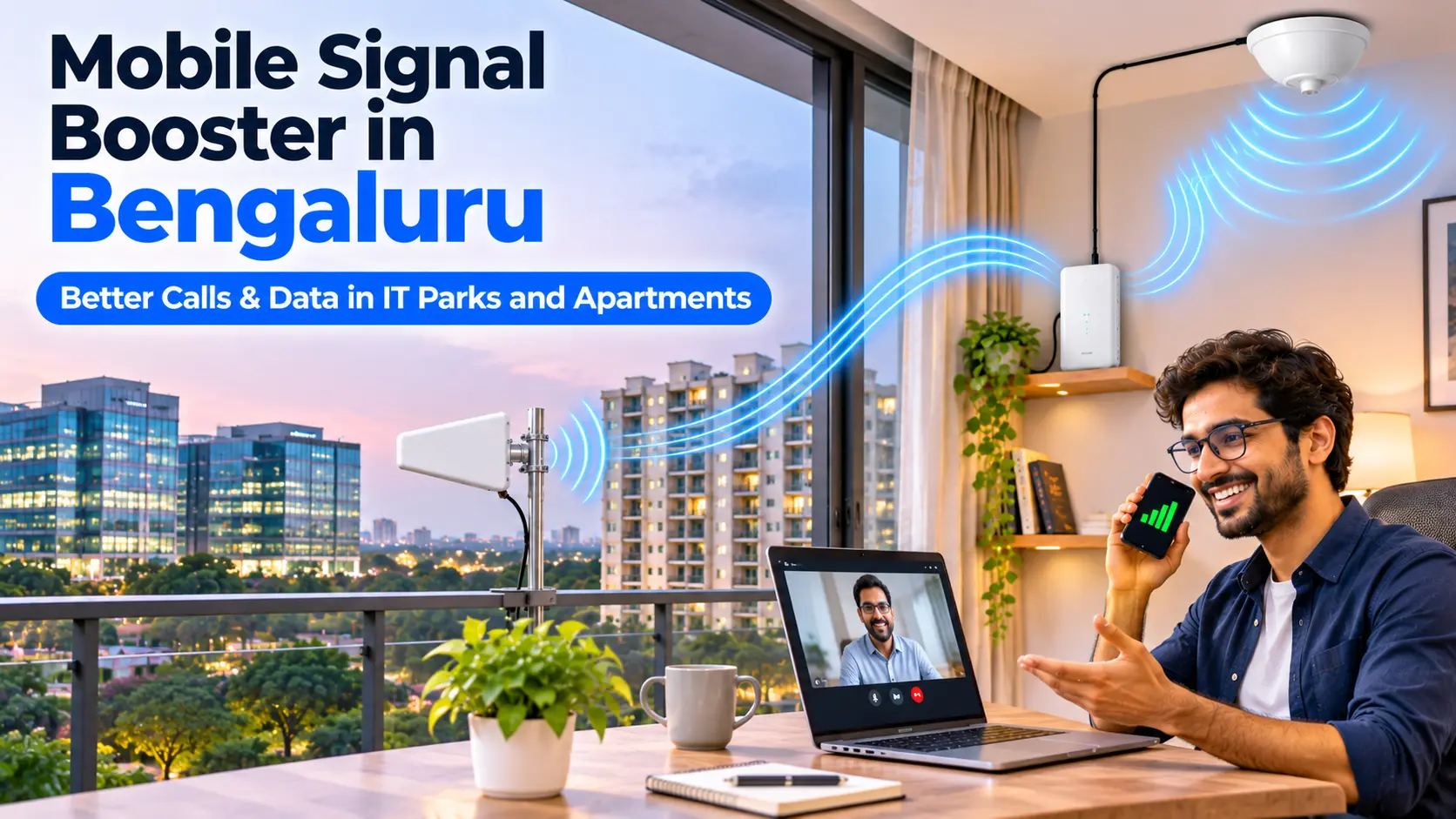
Bengaluru, India’s main technology hub, is full of sprawling IT parks, high-rise apartment complexes and deep basements. Yet thousands of professionals, residents and businesses face daily mobile problems: dropped calls, delayed messages, broken voice and unusable data inside buildings.
Choosing the right mobile signal booster in Bengaluru starts with understanding why signal fails inside modern concrete buildings and how indoor amplification works. Whether you manage a tech office on the Outer Ring Road, live in a Whitefield high-rise or run a business with basement parking, fixing dead zones means matching the setup to your building and your operator’s bands.
Why Mobile Signal Fails in Bengaluru’s Tech Corridors and Apartments
Weak indoor signal in Bengaluru is rarely caused by a lack of towers. It usually comes from the building itself, its height and its surroundings. Knowing the cause helps you pick the right fix.
1. Building Materials and Signal Loss
Offices and residential towers in Bengaluru use reinforced cement concrete (RCC), steel frames, dense brickwork and energy-efficient glass. Low-E glass panels cut heat, but their metallic coating reflects mobile signals and keeps them out of inner rooms. Steel beams and thick concrete absorb signal, so it gets weaker the deeper you go into the building.
2. High-Rise Shadow Zones and Interference
In apartment towers across Bellandur, Sarjapur Road and Electronic City, signal changes a lot from floor to floor:
- Lower Floors: Nearby buildings, boundary walls and trees block the direct path to the nearest tower, creating shadow zones.
- Upper Floors: Above the surrounding buildings, phones pick up competing signals from several distant towers with no single strong one. Handovers fail, causing dropped calls and unstable data even with full bars.
3. Basements and Underground Spaces
Multi-level basements used for parking, utilities, cafeterias or workspaces sit fully below ground. Soil, foundations and concrete walls block mobile signal completely, so these spaces need a booster to get any coverage.
4. Network Congestion in Corporate Hubs
Whitefield, Manyata Tech Park, Bagmane Tech Park and the Outer Ring Road (ORR) have tens of thousands of active phones during office hours. This load strains local towers, so calls and data can fail even when your phone shows full bars. Note that a booster fixes weak signal, not an overloaded tower. If your signal is strong but data is still slow at peak hours, congestion is the cause, and only the operator can add capacity.
How Mobile Signal Booster Systems Work
A mobile signal booster (also called a cellular signal amplifier or repeater) captures usable signal outside, amplifies it, and spreads it into weak areas inside the building.
A standard booster system has four parts:
| Component | Function | Installation Tip |
|---|---|---|
| Outdoor (Donor) Antenna | Captures signal from nearby operator towers. | Mount it outside (roof or high wall) where signal is stable and usable. |
| Signal Booster Unit | Amplifies incoming (downlink) and outgoing (uplink) signals. | Keep it well isolated from the indoor antennas to prevent feedback (oscillation). |
| Indoor (Service) Antenna | Spreads the boosted signal inside living or working areas. | Place it centrally: ceiling dome for open rooms, wall panel for corridors. |
| Coaxial Cable | Carries the signal between the antennas and the booster. | Use low-loss 50-ohm cable and avoid unnecessary length and joints. |
A booster does not create signal. It needs usable signal outside. If there is no signal at all on the roof or balcony, it cannot help indoors. Here’s how to check your signal strength before you buy.
Network Bands and 5G in Bengaluru
A booster only works if it covers the bands your operator uses at your location. In Bengaluru, as in the rest of India:
- Jio: 4G on 850 MHz (Band 5), 1800 MHz (Band 3) and 2300 MHz (Band 40); 5G on 3500 MHz (n78) and 700 MHz (n28). Jio has no 2G, so all calls are VoLTE.
- Airtel: 4G on 900 MHz (Band 8), 1800 MHz, 2100 MHz (Band 1) and 2300 MHz; 5G on 3500 MHz (n78).
- Vi: 4G on 900, 1800, 2100 and 2300 MHz, with 2500 MHz in some circles; 5G on 3500 MHz in select cities.
- BSNL: 4G on 2100 MHz and 700 MHz (nationwide since 2025) and 2G on 900 MHz.
So a 900/1800/2100 MHz kit suits Airtel, Vi, BSNL and mixed-SIM homes, while Jio users need 850/1800/2300 MHz. For a full comparison, see our Jio vs Airtel vs Vi vs BSNL band comparison.
What about 5G? Jio and Airtel 5G are widely available across Bengaluru, but 5G on 3500 MHz is the band that suffers most inside concrete buildings. Your phone falls back to 4G indoors, so a good 4G booster already fixes calls and most data. If you need 5G speeds indoors, see our 5G booster guide and 4G vs 5G booster comparison.
Booster Setups for Bengaluru Apartments, IT Offices and Basements
1. Apartments (Whitefield, Sarjapur Road, Bellandur, Electronic City)
For a 1–2 BHK flat, a tri-band kit with the outdoor antenna on the balcony or terrace and one indoor antenna in the central room usually covers the whole home. On lower floors blocked by nearby towers, a directional antenna aimed through a gap between buildings gives the cleanest signal. Larger flats and villas need more indoor antennas.
2. IT Offices and Tech Parks
Offices along the ORR, in Manyata or in Electronic City face glass facades, deep floor plates and metal partitions. They need higher-power commercial boosters with several ceiling antennas spread across the floor. In large multi-tenant tech parks, coverage is often managed by the building or the operators, so check with facility management first; boosters suit individual offices, floors and standalone buildings best.
3. Basements and Parking
The outdoor antenna goes on the roof or at ground level outside, and cable runs down to a booster and indoor antennas in the basement. Large parking levels need several antennas connected through splitters.
| Property Type | Typical Setup | Bands to Look For | Typical Cost |
|---|---|---|---|
| 1–2 BHK apartment | Balcony or terrace antenna + one indoor antenna | 900/1800/2100 MHz (Airtel, Vi, BSNL) or 850/1800/2300 MHz (Jio) | ₹12,999 tri-band kit |
| Large flat / villa | Rooftop antenna + splitter + 2–3 indoor antennas | Tri-band matched to your operator | Quoted on details |
| IT office floor | Commercial booster + several ceiling antennas | Multi-band for all operators | Quoted on details |
| Basement / parking | High-gain outdoor antenna + long cable + panel or dome antennas | Low bands (850/900 MHz) plus 1800 MHz | Quoted on details |
Things to Check Before You Buy
- Outdoor Signal: You need at least 1–2 stable bars (about -100 to -110 dBm) on the roof, terrace or balcony.
- Your Operator’s Bands: Match the kit to the operator most people at home or in the office use.
- Antenna Separation: Keep the outdoor and indoor antennas well apart, ideally with a concrete slab or wall between them, to avoid feedback.
- Society or Building Rules: Apartment associations and tech parks often control terrace access and outdoor cabling, so get permission first.
- Realistic Expectations: A booster fixes weak signal and call drops; it cannot add capacity to a congested tower.
Getting a Mobile Signal Booster in Bengaluru
We ship our booster kits across India, including Bengaluru. Before you order, our team helps you check your outdoor signal and pick the right kit for your operator. After delivery, we guide you through mounting the antennas, routing the cable and testing every room over phone and WhatsApp video.
- All Network Tri-Band Kit (900/1800/2100 MHz) — ₹12,999: for Airtel, Vi, BSNL and mixed-SIM homes.
- Jio Tri-Band Kit (850/1800/2300 MHz) — ₹12,999: for Jio homes.
For larger homes, offices and basements, share photos and signal readings on WhatsApp and we’ll suggest a setup. Comparing options? Read our best signal booster for home guide.
Frequently Asked Questions
1. Will a signal booster work if there is no signal outside my building?
No. A booster amplifies existing signal. If there is no usable signal on your roof, terrace or balcony, it has nothing to boost.
2. Can a booster fix slow data in a busy tech park?
Only if the problem is weak signal. If your phone shows strong signal but data is slow at peak hours, the tower is congested, and a booster cannot add capacity.
3. Can one booster support Jio, Airtel and Vi together?
Only if it covers the bands all of them use at your location. A 900/1800/2100 MHz kit covers Airtel, Vi and BSNL, but only Jio’s 1800 MHz band. A Jio 850/1800/2300 MHz kit covers all Jio 4G bands and also helps Airtel and Vi on 1800 and 2300 MHz.
4. Why do I lose signal on high floors in Whitefield or Sarjapur Road?
On high floors, phones receive similar signals from several distant towers and keep switching between them, which drops calls. Lower floors are often blocked by nearby buildings instead.
5. Will a booster give me 5G indoors?
Only a 5G-capable booster does. Most homes get reliable calls and data from a 4G booster, because phones fall back to 4G indoors. See our 5G booster guide if you need 5G speeds inside.
6. Do you deliver signal boosters to Bengaluru?
Yes. We ship our kits to Bengaluru and guide you through installation over phone and WhatsApp video.
Conclusion
Weak indoor signal in Bengaluru comes from RCC and glass buildings, high-rise interference and deep basements, and sometimes from congested towers in busy tech hubs. A correctly chosen booster fixes building-related dead zones and call drops at home or at work.
Check your outdoor signal, match the kit to your operator’s bands, keep the antennas well apart, and set realistic expectations about congestion. For guidance on the right setup for your apartment, office or basement, contact MobileSignalAmplifier.com.
Weak signal in Bengaluru? Call 09769403018 or WhatsApp us. We’ll help you pick the right kit for your operator and guide your installation.